
Buildings · Hawaiʻi
Commentary
The electrical wall: old wiring is the quiet limit on Hawaiʻi’s energy plans
No one has surveyed the electrical panels in Hawaiʻi’s homes. A field estimate suggests about a third would need work before adding cooling and a battery. There is a cheaper way around the wall than through it.
September 17, 2026 · 6 min read
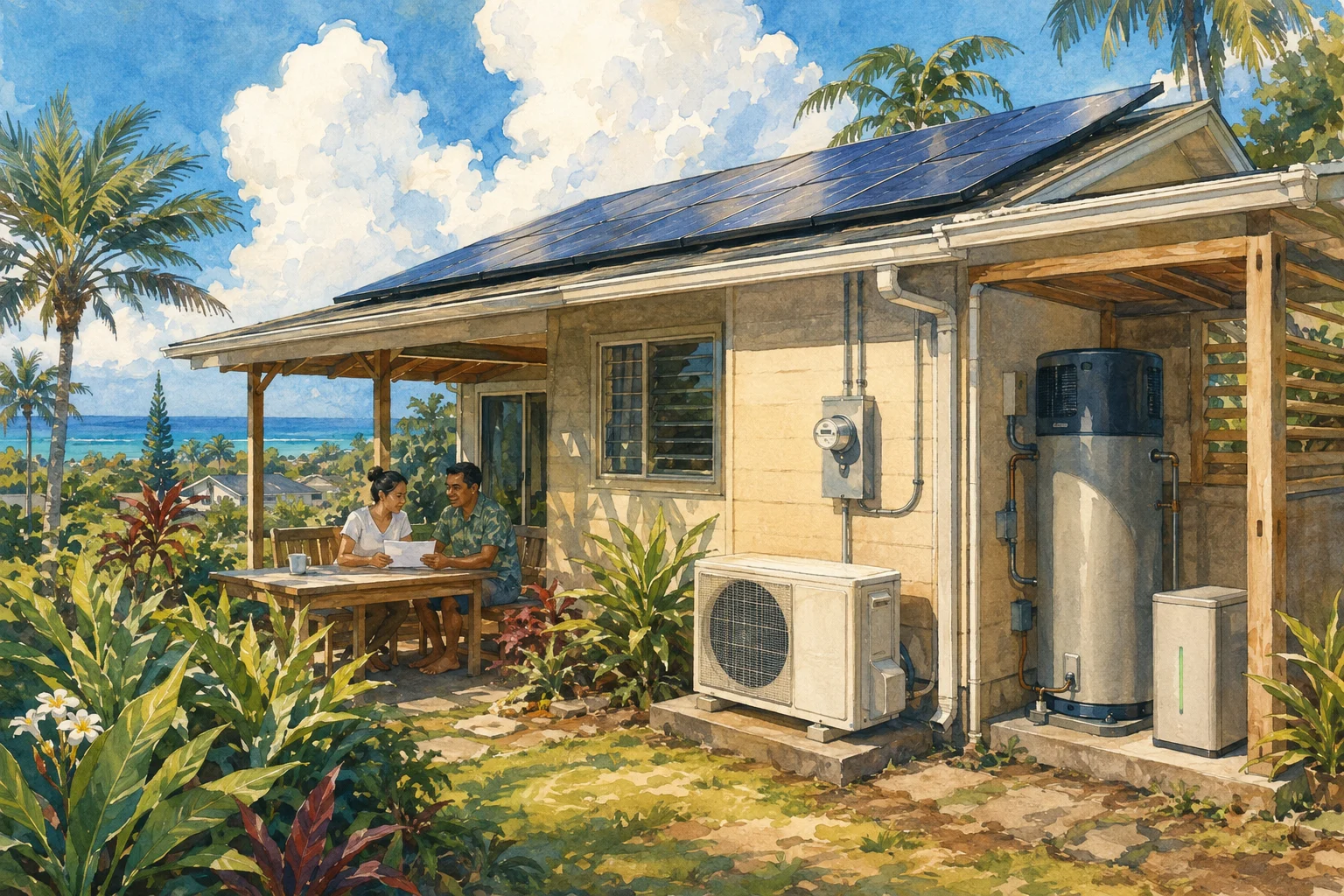
Every plan for Hawaiʻi’s homes, from rooftop solar to heat pumps to the battery on the carport wall, ends at the same gray metal door: the electrical panel. Behind it is a number, the rating of the main breaker, and behind that a second number, the capacity of the service from Hawaiian Electric’s line. Together they decide what a house can add without new wiring, a permit and, sometimes, a utility crew.
Hawaiʻi’s housing is old. UHERO’s 2023 housing factbook put the median home’s construction year at about 1980 and found the state’s stock aging faster than any other state’s. Homes of that vintage were wired for the loads of their time. As evenings warm and households add cooling, the panel is where an energy plan meets the house.
I call this the electrical wall. It is not a single barrier, and its height is not known. That second fact is the first problem.
What no one has counted
There is no statewide survey of residential electrical panels in Hawaiʻi. The state does not know how many homes have a 100-amp service, how many have 200, or how many would need an upgrade to add a heat pump and a battery.
National studies give a range. A 2024 study by the Electric Power Research Institute found that 21% of U.S. homes have a main breaker of 100 amps or less, and that a standard code load calculation would send 21.1% of the country’s 76.6 million single-family homes, 16.2 million houses, to a service upgrade for full electrification. Lawrence Berkeley National Laboratory has estimated that about a third of homes are on 100-amp service.
For Hawaiʻi, the Federation’s model uses a field estimate, and it should be read as one: 35% of the state’s roughly 490,000 households would need a panel upgrade, about 171,500 homes, and half of those would also need a larger utility service, about 85,750. At $2,500 for a panel and $4,500 for a service, the total is about $815 million, with a typical wait of about 26 weeks. Spread across every household in the state, that is about $1,660 each. For a home that needs both, it is $7,000.
The 35% is the input in this model most in need of a real measurement. It is set above the national figures on the reasoning that Hawaiʻi’s stock is older and more of it was built without cooling in mind. If the true share is 20%, the total falls to about $465 million. If it is 45%, it passes $1 billion. The panel below lets you set the share yourself.
The figures come from Airform's open grid model, re-run on this page; Airform, which makes heat-pump and battery equipment, publishes the assumptions at airformdata.com.
The permit line
An upgrade is also a permit. In findings attached to a 2026 bill on county permitting, the Legislature described the state of building permits in Honolulu in 2022 and 2023:
During 2022 and 2023, more than ninety per cent of all state building permit applications submitted to the department of planning and permitting of the city and county of Honolulu took longer than one hundred eighty days to obtain approval, with the average approval length being approximately six hundred days.— Hawaiʻi State Legislature, SB 2066 SD1, Relating to County Permitting and Inspection, legislative findings, 2026 session
Those findings cover building permits in general. They do not break out the electrical permits a panel swap requires, which may move on a different track. And the picture has improved. A Civil Beat analysis of city data, published in June, found that the median wait for a new building permit fell to 2.5 months between August 2025 and April 2026, from about four months a year earlier, while permits processed rose to about 17,000 from 12,000. The same analysis found commercial permits slowing, to a median of about four months, and 76 of the department’s 365 positions vacant.
A service upgrade adds a second queue: Hawaiian Electric’s own design and field work, required whenever a service is upgraded or modified. The model’s 26-week wait is an estimate for the whole sequence, not a measured figure.
Around the wall
The more useful question is how many homes have to go through the wall at all. The National Electrical Code lets the setpoint of an energy management system count in a home’s load calculation, under section 220.70 and Article 750, a point Lawrence Berkeley National Laboratory made in a 2024 review. A house that is never allowed to draw more than its service can carry does not need a bigger service.
Berkeley Lab’s earlier work described all-electric homes on a 100-amp panel, using power-efficient equipment, circuit sharing and load management. Peninsula Clean Energy, a California community power agency, found that 95% of its all-electric retrofits needed no service upgrade, and that the typical home peaked at 29 amps.
Batteries extend the same idea. A battery that supplies the compressor through the evening peak lets the service see a smaller load than the equipment’s nameplate suggests. The panel stays. The peak moves.
One building, two electrical rooms
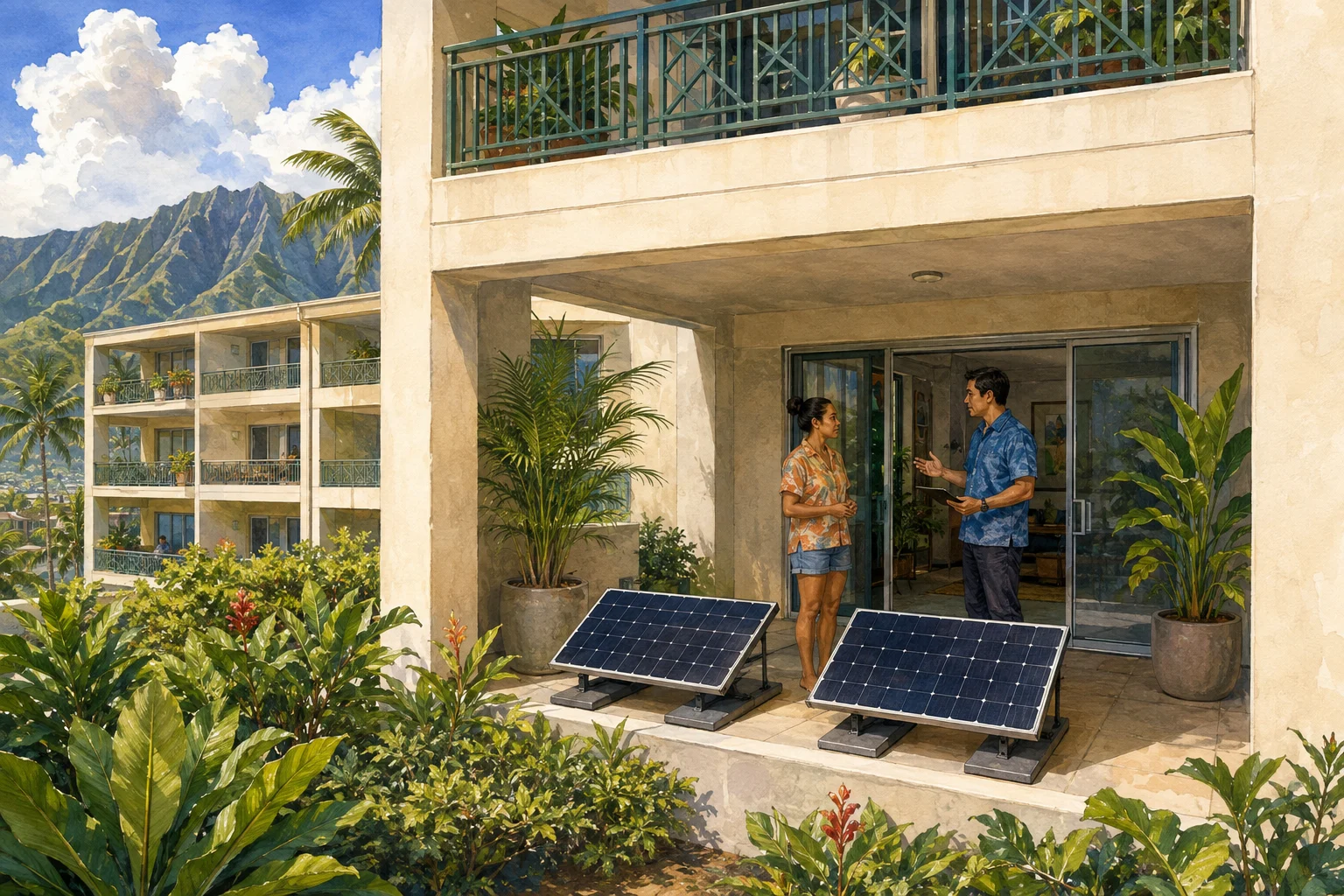
The effect is largest in apartment buildings, where the service is shared and replacing it is a construction project. The Federation’s building model takes an eight-storey building of 80 apartments, each adding two cooling units, and sizes its electrical service two ways.
With ordinary equipment, the building’s peak comes to about 188 kilowatts, which calls for an 800-amp service at 208 volts. With every unit carrying a battery and its grid draw capped through the peak, the peak is about 96 kilowatts, and a 400-amp service is enough. The model prices a new service at about $226,500 in the first case and $183,000 in the second; both include about $120,000 of fixed costs for the service lateral, engineering and permits. A building that already has 400 amps may need no new service at all.
These are planning figures, not a stamped load calculation. They show the shape of the choice: a peak of 2.35 kilowatts per apartment against 1.2.
The case for the bigger panel
The strongest argument against managing around the wall is that an upgrade is done once and lasts. A 200-amp panel takes an electric-vehicle charger, an induction range and the next appliance without a controller deciding what can run. Load management adds equipment that can fail and settings an owner may not understand. Batteries cost more than panels: at EnergySage’s national average of about $1,100 per kilowatt-hour installed, a 10 kilowatt-hour battery runs about $11,000, against the model’s $2,500 for a panel. And some old panels should be replaced for safety, whatever is added to them.
All of that is true, and it argues for a choice rather than a rule. Today the conventional path is the bigger service. A service-capacity standard that let managed loads count, in Honolulu’s plan review and in Hawaiian Electric’s service applications, would let the homes that can go around the wall do so, and save the crews and the queue for the homes that cannot.
Money is the other half. Hawaii Energy’s rebates for 2026 and 2027 pay up to $550 per mini-split unit and $1,250 for a central air-conditioning retrofit, and its executive director frames them around exactly this moment in a house’s life:
Whether it's replacing an aging water heater or upgrading cooling equipment, our rebates help make those investments more affordable.— Caroline Carl, Executive Director, Hawaii Energy, July 7, 2026
None of the rebates in that announcement covers a panel. The state green bank’s $18 million in new loan capital, announced in January, lists solar, batteries, solar and heat-pump water heaters and commercial efficiency retrofits as eligible uses. Panels and services are not on the list.
Count first
I would start with the survey. A sample of a few thousand panels, drawn from permit records and utility service data, would replace the model’s 35% with a measured number and tell the state whether its electrical wall stands in front of tens of thousands of homes or well over a hundred thousand. Policy can follow the count: a service-capacity standard where managed loads are enough, financing for upgrades where they are not.
Until then, every energy goal set for Hawaiʻi’s homes rests on a guess about what sits behind a gray metal door.
Josh Leong works with Form Industries, which builds heat-pump and battery equipment and publishes the models used here.
Read next

Commentary · Hawaiʻi · October 1, 2026
CommentaryHawaiʻi cannot import its way to 2045
The state ships in the fuel, the equipment and, increasingly, the skilled labor its energy plan depends on. The part it can most realistically keep at home is the work of assembli…
Markets · Hawaiʻi · California · September 24, 2026
AnalysisHawaiʻi’s electricity hit 52.72 cents in June, nearly triple the U.S. average
Federal data put the state’s residential price up almost 29% in a year, and oil explains the swing. California’s high prices have a different cause. The hour of use is the one par…

Markets · Hawaiʻi · California · September 11, 2026
AnalysisWhat California’s energy fights can teach Hawaiʻi, and what they can’t
California has more than 21,000 megawatts of batteries and some of the country’s steepest rate increases. Its export tariff, wildfire bills and connection deadlines give Hawaiʻi a…