
The docket · PMF-HI-26-007 · Hawaiʻi · DRAFT
Model proposal · not current law
Electrical Capacity Before Service Upgrades
Before a household or building is told it needs a new panel or utility service to add cooling or electric equipment, a load calculation using measured demand and available load management — energy-management systems, circuit sharing, battery-carried loads — would be required. Paired with a statewide panel survey, published utility service-upgrade timelines and faster permits.
October 2026 · Model proposal for code, utility and program rules
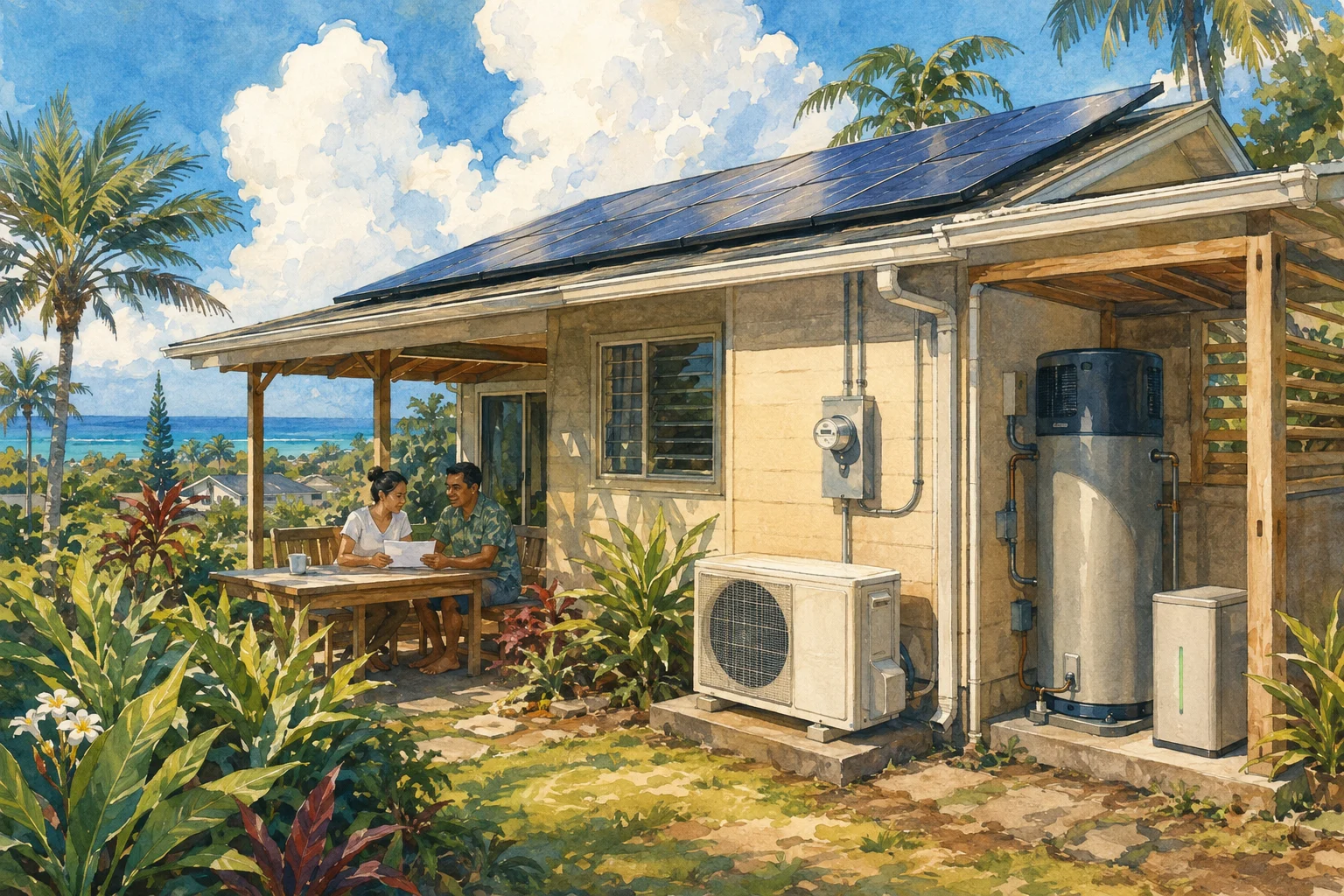
Much of Hawaiʻi’s housing was wired for a climate that did not require air conditioning. Adding a heat pump, an induction range or a car charger can trip a load calculation that leads to a new panel, a larger utility service or both, with the cost, permit and utility scheduling that each involves. No statewide survey of residential panel or service sizes exists, so no one knows how many homes are affected. Airform’s model uses a field estimate of 35 percent of Hawaiʻi’s roughly 490,000 households, or about 171,500 homes, with an aggregate cost near $815 million and a typical wait around 26 weeks. It is an estimate, not a measurement.
National research suggests a large share of upgrades can be avoided. EPRI estimated in 2024 that a standard National Electrical Code calculation sends about 21 percent of U.S. single-family homes to a service upgrade for full electrification. Lawrence Berkeley National Laboratory has documented how power-efficient equipment, circuit sharing and load management can electrify a home on a 100-amp panel. In California, Peninsula Clean Energy reported that 95 percent of its all-electric retrofits needed no service upgrade; the typical home peaked at 29 amps.
The code is moving, and Hawaiʻi is a cycle behind. The 2023 NEC added Section 220.70, which lets an energy-management system’s setting count in the load calculation. Hawaiʻi’s State Building Code Council adopted the 2020 NEC in March 2022, with counties required to adopt it by March 2024. The 2020 edition already lets existing dwellings use a year of measured peak demand (Section 220.87) instead of a nameplate tally.
When an upgrade is needed, timing matters. California’s SB 410 and AB 50 led the CPUC to set energization targets in September 2024 — an average of 182 days for line-extension work, with reporting on every delay — that it says could cut maximum timelines by up to 49 percent. PMF found no published Hawaiian Electric target for completing residential service upgrades. Honolulu permits have improved: a Civil Beat analysis found the median wait for a new building permit fell to about 2.5 months between August 2025 and April 2026, after legislative findings that more than 90 percent of applications in 2022–23 took over 180 days.
The record
The record
Hawaiʻi has no statewide survey of residential electrical panel or service capacity. The State Building Code Council adopted the 2020 NEC on March 15, 2022, with counties required to adopt it, with amendments, by March 14, 2024. The 2023 NEC’s Section 220.70 allows an energy-management system setpoint to be used in load calculations; Section 220.87 in the 2020 edition permits existing-dwelling calculations based on a year of measured peak demand. Upgrading or modifying a service requires Hawaiian Electric design and field work.
What national research says
EPRI (ACEEE Summer Study, 2024): about 21 percent of U.S. homes have panels of 100 amps or less; a standard NEC calculation sends 21.1 percent of 76.6 million single-family homes to a service upgrade for full electrification, or 11.3 percent without electric-resistance backup; upgrades cost $2,000 to $30,000 and can take six to nine months. LBNL (2024): about a third of homes are on 100-amp service. Peninsula Clean Energy: 95 percent of its all-electric retrofits needed no service upgrade.
What California did
Under SB 410 and AB 50 (2023), the CPUC on September 12, 2024, set energization targets for PG&E, SCE and SDG&E: average targets of 182 days and maximums of 306 to 357 days for line-extension types, separate short targets for main-panel upgrades, maximum timelines for circuit and substation upgrades, biannual reporting and a customer delay-reporting form. The CPUC said maximum timelines could fall by up to 49 percent if targets are met.
Permits in Honolulu
Findings in SB 2066 SD1 (2026) state that during 2022 and 2023 more than 90 percent of building permit applications to Honolulu’s Department of Planning and Permitting took longer than 180 days, averaging about 600 days. A Civil Beat analysis of DPP data found the median wait for a new building permit fell to about 2.5 months between August 2025 and April 2026, from about 4 months, with 76 of 365 department positions vacant.
What the model shows
Airform’s model applies a field estimate of 35 percent to about 490,000 Hawaiʻi households: about 171,500 homes needing panel upgrades, 85,750 of them also needing service upgrades, about $815 million in total, with a typical wait near 26 weeks. For an illustrative eight-storey building, managing peak load with batteries cuts the required service from about 188 kW and 800 amps to 96 kW and 400 amps, and service-equipment cost from about $226,500 to $183,000.
What we propose
- 01Require publicly funded or utility-incentivized electrification projects to document a load calculation using 12 months of measured demand (NEC 220.87) and an evaluation of listed load-management options before funding a panel or service upgrade; fund the upgrade where the managed calculation still fails.
- 02Ask the State Building Code Council and the counties to adopt the 2023 NEC’s energy-management provisions (Section 220.70 and Article 750) in the next code cycle, or an equivalent state amendment sooner.
- 03Require energy-management and power-control equipment used to avoid an upgrade to be listed for the purpose, with tamper-resistant, labeled settings verified at inspection.
- 04Direct the State Energy Office, with Hawaiian Electric and the counties, to conduct a statewide residential panel and service survey — combining permit records, meter data and a stratified field sample — and publish results by island and housing type by December 31, 2027.
- 05Ask the PUC to set average and maximum target times for the utility-controlled steps of residential and small-commercial service upgrades, with semiannual public reports of actual times and causes of delay, modeled on the CPUC’s energization framework.
- 06Allow licensed electricians to obtain same-week or over-the-counter permits for like-for-like panel replacements and listed load-management installations, with inspection of a random sample.
- 07Give customers free access to 12 months of their interval demand data in a standard format for use in load calculations.
Who pays, who benefits
- Households that need panel or service upgrades pay $2,000 to $30,000 each by EPRI’s national range; PMF has no Hawaiʻi-specific price survey. Load-management equipment generally costs less than a service upgrade, but prices vary and PMF has not surveyed them locally.
- In aggregate, the model’s field estimate puts Hawaiʻi’s panel-upgrade exposure near $815 million. If load management avoided even a fraction of those upgrades, the savings would be in the tens to hundreds of millions of dollars; the survey is needed to narrow that range.
- Utility-side upgrades — transformers and service drops — are paid partly by the requesting customer and partly by all ratepayers under utility rules, and transformer supply has been constrained nationally. Avoided upgrades reduce both.
- The survey, data access and reporting requirements carry modest public and utility administrative costs, small relative to the upgrade spending they inform.
Test the numbers
Objections
“Load management caps what a household can run at once. Families will outgrow it, especially when they add an electric vehicle.”
The standard does not prohibit upgrades; it requires the managed option to be evaluated first and funds the upgrade when the calculation fails. Households can choose an upgrade with their own money at any time.
“An energy-management device that fails could overload a service. The safest answer is more capacity.”
That is why the proposal requires listed equipment, tamper-resistant settings and inspection. The 2023 NEC itself now recognizes energy-management systems in load calculations, subject to those safeguards.
“Utility service-upgrade timelines depend on transformer supply and crew availability; targets will not change that.”
Targets with public reporting identify where delays occur and why, which California’s experience shows is the precondition for fixing them. Fewer avoidable upgrade requests also free crews and transformers for upgrades that are necessary.
What to watch
- The State Building Code Council’s next electrical-code adoption cycle and whether it takes up the 2023 NEC energy-management provisions.
- PUC Docket No. 2026-0084: whether device data from enrolled batteries and controls can support load calculations.
- CPUC Rulemaking R.24-01-018, Phase 2: revisions to California’s energization targets and the utilities’ biannual reports.
- Honolulu Department of Planning and Permitting processing data, and any 2027 county permitting legislation following the SB 2066 findings.
Sources
- EPRI, “Defining the Electrical Panel Barrier to Residential Electrification,” ACEEE Summer Study, 2024
- LBNL, “Low-Power Electrification, the NEC and Building Energy Codes,” April 2024
- LBNL, “All-Electric Homes on a 100A Panel,” February 2023
- Canary Media, Peninsula Clean Energy retrofit data (95 percent without service upgrade), January 2026
- County of Kauaʻi, 2020 NEC code adoption notice (State Building Code Council adoption dates)
- Hawaiian Electric, Upgrade, modify or install service
- CPUC fact sheet, “CPUC Approves Decision to Support Timely Connection of New Customers to the Electrical Grid” (SB 410 / AB 50, R.24-01-018), September 12, 2024
- SB 2066 SD1 (2026), “Relating to County Permitting and Inspection,” legislative findings
- Civil Beat, “Honolulu building permits moving faster for homes, slower for businesses,” June 2026 (news analysis of DPP data)
- Airform open grid and building models (assumptions and sources); Airform makes heat-pump and battery equipment
Reporting
Buildings · Hawaiʻi · September 17, 2026
CommentaryThe electrical wall: old wiring is the quiet limit on Hawaiʻi’s energy plans
No one has surveyed the electrical panels in Hawaiʻi’s homes. A field estimate suggests about a third would need work before adding cooling and a battery. There is a cheaper way a…

Markets · Hawaiʻi · California · September 11, 2026
AnalysisWhat California’s energy fights can teach Hawaiʻi, and what they can’t
California has more than 21,000 megawatts of batteries and some of the country’s steepest rate increases. Its export tariff, wildfire bills and connection deadlines give Hawaiʻi a…