
Commentary · Hawaiʻi
Commentary
Hawaiʻi cannot import its way to 2045
The state ships in the fuel, the equipment and, increasingly, the skilled labor its energy plan depends on. The part it can most realistically keep at home is the work of assembling, installing and maintaining what arrives.
October 1, 2026 · 6 min read
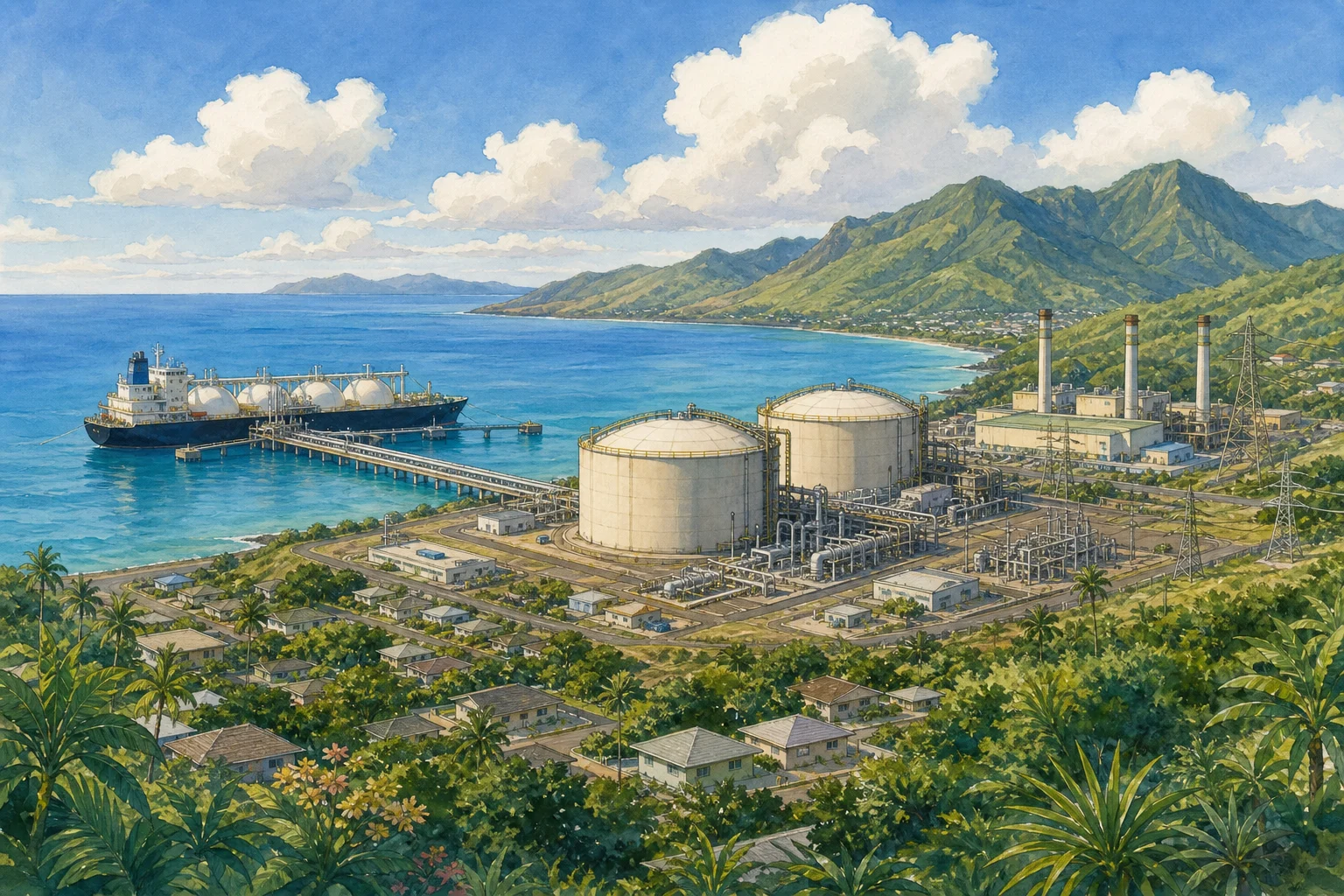
On April 1, 2026, Hawaiian Electric told its customers that a war on the other side of the world was about to reach their electric bills. With oil prices climbing on the conflict with Iran, the utility said “typical residential bills may rise between 20% and 30% over the next several months.”
We recognize that Hawaii already faces a high cost of living and any increase in energy costs places an additional burden on our families and businesses.— Rebecca Dayhuff Matsushima, Vice President of Customer Service, Hawaiian Electric, April 1, 2026
The warning was close. In EIA data, Hawaiʻi’s average residential price went from 39.79 cents per kilowatt-hour in January to 52.72 cents in June, a 32 percent rise in five months, before easing to 48.00 cents in July. Hawaiʻi’s homes and power plants were much the same in June as in January. The price of a commodity that arrives by ship was not.
I should say up front that I have a stake in this argument; the disclosure is at the end. The argument is this: Hawaiʻi’s energy plan treats imports as a fuel problem, and they are also a labor and maintenance problem.
The price of distance
Hawaiian Electric says the state “relies heavily on imported fuel for electricity generation,” and that it has “reduced its use of oil by 55 million gallons annually since 2008.” Both are true. In 2025 the utility reached a renewable portfolio standard of 36.8 percent of generation across its territory, and 32.3 percent on Oʻahu. Nearly all of the rest came from fuel that crossed an ocean.
The law requires 40 percent by the end of 2030, 70 percent by 2040 and 100 percent by 2045. From 36.8 percent in 2025, reaching 100 percent in 20 years means adding a little over 3 percentage points every year. Hawaiian Electric expects the solar and storage projects coming online in 2026 to add about 2 points. That is the right direction at roughly two-thirds of the needed pace.
And the replacement for imported oil is, at first, imported equipment. Every panel, battery, heat pump and spool of copper line set crosses the Pacific too. Since January 1, 2026, the Section 301 tariff on non-electric-vehicle lithium-ion batteries from China has been 25 percent, up from 7.5 percent. The Federation’s model assumes a Hawaiʻi install costs 1.25 times the mainland figure because of what arrives by ship; that is an assumption, not a measured premium.
The people who do the work
The equipment is the part you can order. The labor is harder. Federal wage data for May 2025 count 3,070 electricians in Hawaiʻi, at an annual mean wage of $92,870, above California’s $85,860 and the national $71,490, and 1,300 heating, air-conditioning and refrigeration mechanics, at $67,070. California’s HVAC mechanics average $75,370, so a Hawaiʻi technician can earn more, on average, by moving.
Many do leave. The state’s population fell by 2,132 in 2025, to 1,432,820, and net domestic migration was negative 8,876, about 24 people a day. The apprenticeship system is a bright spot: the Department of Labor and Industrial Relations counted 5,406 registered apprentices in December 2024, and 1,621 new or reinstated apprentices in the year to September 2024. But those apprentices are entering a national market that wants them too.
About 72,700 openings for electricians are projected each year, on average, over the decade.— U.S. Bureau of Labor Statistics, Occupational Outlook Handbook, Electricians, 2025–35 projections
Governor Green’s Executive Order 25-01, signed in January 2025, set a goal of 50,000 distributed renewable installations, such as rooftop solar and batteries, by 2030. That is about 10,000 a year. Suppose the state tried to retrofit homes with heat pumps at the same pace. That goal is about a different machine, but it is the same labor pool.
The figures come from Airform’s open grid model, re-run on this page; Airform, which makes heat-pump and battery equipment, publishes the assumptions at airformdata.com.
At 10,000 homes a year, the model needs about 346 full-time field workers: 156 HVAC technicians, 122 helpers and 68 electricians. The 156 technicians are about 12 percent of every HVAC mechanic in the state, and about 80 percent of the 15 percent the model assumes could be spared from other work. Cut field hours by 60 percent and the requirement falls to about 159 workers, including 62 technicians. Drag the pace and the hours to see where the workforce runs out.
Where the hours go matters as much as how many there are. In the model, a conventional heat-pump installation in a single-family home costs about $9,768 and takes about 56 trade hours over five days. Labor is $5,240 of that, 54 percent, and an electrical upgrade adds about $1,663. The equipment is less than half the job.
That is the case for local assembly, stated narrowly. Hours spent on a roof or in a crawlspace are the scarcest thing in the system. Hours spent in a shop in Kapolei or Hilo, pre-wiring, pre-charging, testing and kitting equipment so that a site visit takes one day instead of five, come from a wider pool of workers, under better conditions, with less travel. A unit that fails can be repaired from local stock instead of waiting on a container. Change the trade mix in the panel to see which hours dominate.
Buy performance, not products
Hawaiʻi needs to take some drastic steps to reduce energy costs, which have continued to rise and have contributed to the high cost of living for our people.— Gov. Josh Green, Hawaiʻi State Energy Office release on Executive Order 25-01, January 29, 2025
The State does not need to pick machines to act on that. It can pay for results. A program could pay for each kilowatt that is verified available at 7 p.m., and for each year a system keeps doing it, rather than for installation alone. It could require that anything it pays for come with a local service presence, spare parts on island and a set response time for repairs. And it could tie public money to apprenticeship hours on the job, so that every program also trains the people who will maintain what it buys.
The financing already exists. The Hawaiʻi Green Infrastructure Authority’s GEM$ program offers on-bill loans at a fixed 5.5 percent for up to 25 years. At that rate, the model’s $9,768 installation works out to about $60 a month. But a 25-year loan on equipment that will need service long before it is paid off is exactly why the State should be paying for performance and maintenance, not just a ribbon-cutting.

The honest limits
There are real limits to this, and they should be stated plainly. Hawaiʻi will not make battery cells. In 2025, BloombergNEF put average lithium-iron-phosphate pack prices at $76 per kilowatt-hour in China against about $110 in the United States and Europe. A market of about 490,000 households cannot close that gap, and should not try.
Local work also costs more here. Industrial land is scarce, wages are high, and a workshop here buys power from the same expensive grid as everyone else. The strongest objection to everything above is that importing finished equipment is cheaper, and that a local-assembly program is a jobs subsidy dressed as energy policy.
My answer is that the claim is narrower than manufacturing. Keep the parts of the work that are labor-heavy, failure-prone and time-sensitive on island: final assembly and testing, installation, commissioning, repair and training. Those are the parts where distance costs the most, and where a shortage of people, not a shortage of boxes, is what slows the state down.
Hawaiʻi will keep importing oil until it stops, and it will keep importing equipment long after that. What it can choose to keep is the work.
Josh Leong works with Form Industries, which builds heat-pump and battery equipment and publishes the models used here.
Read next
Labor · Hawaiʻi · September 29, 2026
AnalysisHawaiʻi’s energy goals run through 3,070 electricians and 1,300 HVAC techs
The governor’s goal is 50,000 distributed energy installations by 2030. The licensed trades that would do the work are small, well paid and barely growing. The Federation’s model…
Markets · Hawaiʻi · California · September 24, 2026
AnalysisHawaiʻi’s electricity hit 52.72 cents in June, nearly triple the U.S. average
Federal data put the state’s residential price up almost 29% in a year, and oil explains the swing. California’s high prices have a different cause. The hour of use is the one par…
Buildings · Hawaiʻi · September 17, 2026
CommentaryThe electrical wall: old wiring is the quiet limit on Hawaiʻi’s energy plans
No one has surveyed the electrical panels in Hawaiʻi’s homes. A field estimate suggests about a third would need work before adding cooling and a battery. There is a cheaper way a…