
Markets · Hawaiʻi · California
Analysis
What California’s energy fights can teach Hawaiʻi, and what they can’t
California has more than 21,000 megawatts of batteries and some of the country’s steepest rate increases. Its export tariff, wildfire bills and connection deadlines give Hawaiʻi a tested set of choices, along with several that do not travel.
September 11, 2026 · 7 min read

On December 15, 2022, the California Public Utilities Commission voted to stop paying new rooftop solar owners the retail price for the electricity they send to the grid. Decision D.22-12-056 created the Net Billing Tariff, which applies to interconnection applications filed on or after April 15, 2023. It changed what Californians buy when they buy solar.
Hawaiʻi’s regulators are now writing their own rules for paying customer batteries, in a virtual power plant docket opened in April 2026. They have a neighbor’s record to read, and the two states share an uncomfortable distinction. In EIA data for June 2026, Hawaiʻi’s average residential price was 52.72 cents per kilowatt-hour and California’s was 34.74 cents, against a national average of 18.34. California pays almost twice the national rate. Hawaiʻi pays about 52 percent more than California.
Paying by the hour
The successor tariff also replaces retail rate compensation for exported energy with Avoided Cost Calculator values that vary according to grid needs.— California Public Utilities Commission, Decision D.22-12-056, December 15, 2022
In practice, a kilowatt-hour exported at noon, when California has more solar than it can use, earns little, and one exported in the early evening earns more. The decision locks each customer’s hourly export values for nine years from interconnection, and it judged “a nine-year simple payback for stand-alone solar to be reasonable.” A transitional adder for early customers steps down 20 percent a year and reaches zero after five years.
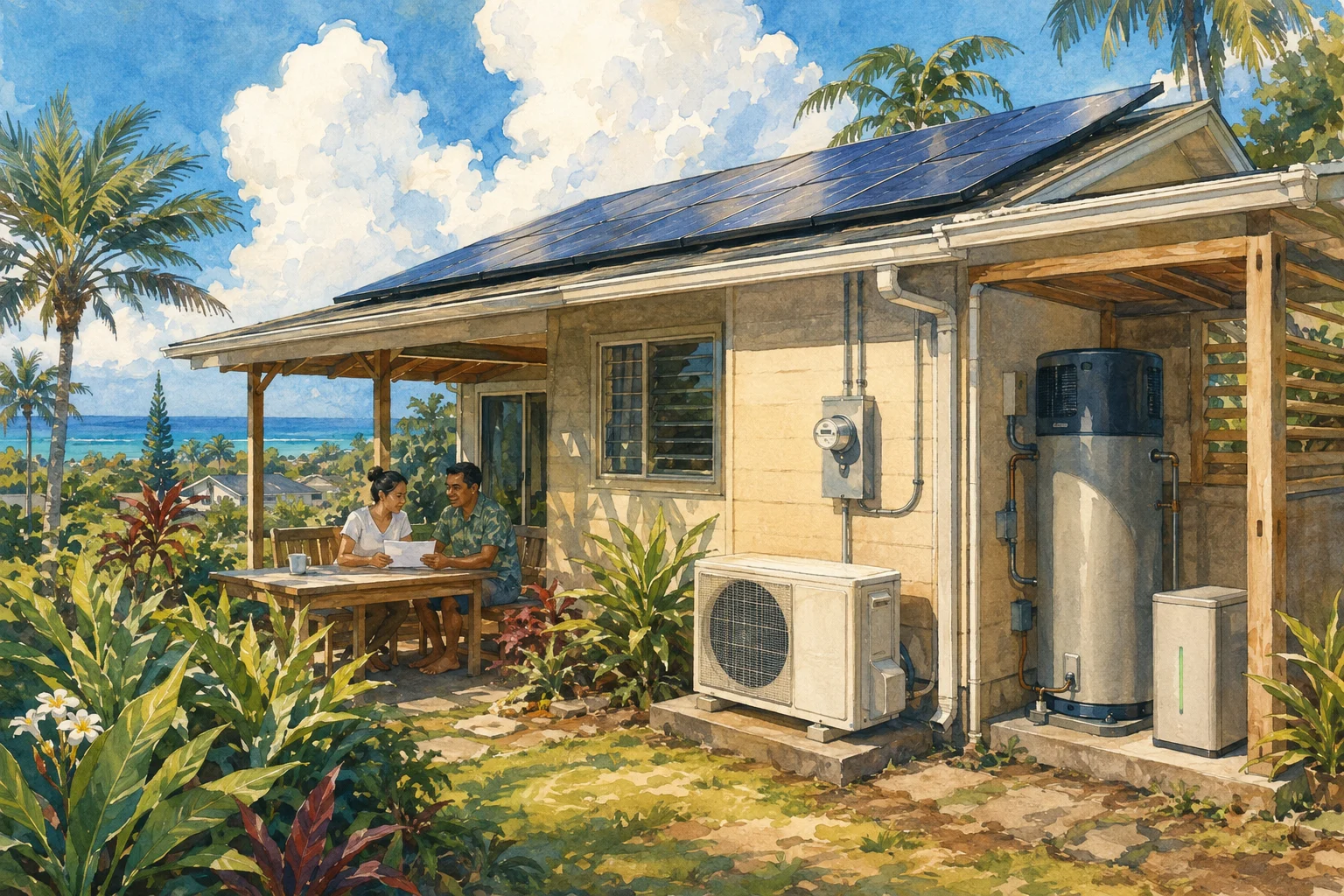
The design rewards pairing solar with a battery, so the energy reaches the grid when it is worth something. Hawaiʻi is already there. Act 266’s findings put the share of residential rooftop solar installations in Hawaiʻi that include storage at 96 percent. What Hawaiʻi lacks is not batteries but a durable way to pay them for the evening.
The bill nobody chose
The Public Advocates Office, the ratepayer advocate inside the CPUC, ranks the drivers of California’s rate increases from January 2016 to June 2026. First on its list: “Wildfire mitigation and wildfire liability costs.” In January 2026, wildfire-related costs made up $3.967 billion of Pacific Gas and Electric’s revenue requirement, 19 percent of the total. They were $2.691 billion at Southern California Edison and $676 million at San Diego Gas & Electric, 14 percent at each. Together that is about $7.3 billion across the three companies.
Rates followed. The advocates put PG&E’s average residential rate up 69 percent over that decade, SCE’s up 101 percent and SDG&E’s up 97 percent. Their headline on households was blunt: “More than 1 in 5 households are behind on their energy bills.” The count is 2,424,244 customers owing an average of $619. Multiplied out, that is about $1.5 billion in arrears.
Hawaiʻi’s version of this bill arrived in 2024, when Hawaiian Electric and its parent agreed to contribute $1.99 billion toward a settlement of more than $4 billion over the 2023 Maui wildfires. How much of Hawaiʻi’s wildfire cost ends up in rates is a separate question. California’s record shows how much room such costs can take up in a utility’s budget once they arrive, and how little of that a battery can touch.
For a household, the difference between the two states shows up in the evening price spread. The Federation’s model uses an approximate PG&E time-of-use shape, about 49 cents in the 4-to-9 p.m. peak against about 31 cents otherwise, an 18-cent spread. On Oʻahu, the Shift and Save pilot priced 5-to-9 p.m. energy at 44.96 cents against 14.99 cents during the day, a spread of almost 30 cents. Shift and Save closed to new enrollment in February 2025, so the Oʻahu figure describes a rate shape rather than a tariff most households can join today.
The figures come from Airform’s open grid model, re-run on this page; Airform, which makes heat-pump and battery equipment, publishes the assumptions at airformdata.com.
On a modeled California bill of about $2,022 a year, shifting evening use onto a home battery saves about $391, and a grid-services program adds about $350, for roughly $741, or 37 percent of the bill. The same model on Oʻahu, with a bill of about $2,635, finds about $705 from shifting and $300 from program payments, roughly 38 percent, plus a one-time $2,000 incentive. Switch the panel between states to compare.
Batteries at scale
California’s other headline number is storage. The California Energy Commission reported in August 2026 that the state had 21,112 megawatts of battery capacity, against less than 700 megawatts when Gov. Gavin Newsom took office in 2019, a more than thirtyfold increase. By the commission’s breakdown, about 16,000 megawatts are utility-scale systems in the state, about 2,000 megawatts sit in Nevada and Arizona on the California grid operator’s system, and about 3,000 megawatts are behind customers’ meters in more than 300,000 systems.
That last figure is the one for Hawaiʻi to study. Three thousand megawatts across 300,000 systems averages about 10 kilowatts per installation, and the total is roughly two and a half times the 1,180-megawatt evening peak the Federation’s model uses for Oʻahu. By comparison, Battery Bonus filled its 40-megawatt Oʻahu cap in December 2023.
California utilities have begun organizing those devices. On September 3, 2026, PG&E announced SHARE, a virtual power plant built with Rewiring America, Google and a group of equipment makers and installers. It will enroll about 21,000 existing devices in Santa Clara and Alameda counties and run through 2027.
This is about delivering power at the speed our economy demands—while improving affordability and reliability for the people we serve.— Chelle Izzi, Chief Commercial Officer, Pacific Gas and Electric, September 3, 2026
Deadlines for connections
California has also started regulating how long it takes to get power. Under Senate Bill 410 and Assembly Bill 50, the CPUC adopted a decision in September 2024 setting energization timelines for the three large investor-owned utilities.
If targets are met by the large three electric IOUs, maximum timelines for grid connections could be reduced up to 49 percent compared to current operations.— California Public Utilities Commission, energization decision fact sheet, September 12, 2024
This newsroom found no comparable timeline in Hawaiʻi for how long a utility may take to upgrade a household’s service. The delays Hawaiʻi has documented are on the permit side: the Legislature’s findings in SB 2066 in 2026 said more than 90 percent of Honolulu building permit applications in 2022 and 2023 took longer than 180 days, with an average of about 600 days. The city has since improved; a Civil Beat analysis of city data put the median wait for a new building permit at about 2.5 months from August 2025 to April 2026.
Batteries can also buy time where wires are short. The Federation’s model includes an illustrative feeder study in West Brentwood and Lone Tree, in eastern Contra Costa County: 6,363 homes, 171 multifamily buildings and 659 commercial accounts, with an illustrative 50-megawatt data-center campus added. On the design day, demand exceeds local capacity by up to 23.8 megawatts for nearly six hours. A coordinated customer fleet supplies 48.5 megawatts of firm capacity at about $945 per kilowatt, against $4,276 for a utility build, and connects the campus 36 months sooner. The comparable Kailua study puts the fleet at $950 and the utility build at $5,205.
Heating, not cooling
That is why I am establishing a goal of 3 million climate-ready and climate-friendly homes by 2030 and 7 million homes by 2035, which shall be supplemented through the deployment of 6 million heat pumps statewide by 2030.— Gov. Gavin Newsom, letter to California Air Resources Board Chair Liane Randolph, July 22, 2022
Heat pumps change the shape of demand differently in each place. In the Federation’s model of a San Francisco winter design day, the city peaks at about 900 megawatts at 5 p.m. Ordinary electrification of heating lifts that to about 1,105 megawatts at 6 p.m., an increase of 205 megawatts, or 23 percent. Coordinating heat pumps and batteries trims about 51 megawatts off the new peak, a quarter of the increase. The model’s yardstick for scale is the Trans Bay Cable’s 400 megawatts.
Oʻahu’s problem runs the other way. The model’s Oʻahu design day is a summer cooling evening peaking at about 1,180 megawatts at 7 p.m., the hour when rooftop solar has faded and oil-fired units carry the load.
What travels
Set side by side, the California record sorts into three piles.
- Transfers directly: paying exports by the hour; locking compensation for a fixed term so households can finance against it, as California did for nine years; and connection deadlines with public reporting.
- Transfers with care: virtual power plants built from devices people already own, judged by verified kilowatts rather than device counts; and a regular public accounting of what drives rates, like the Public Advocates Office’s quarterly report.
- Does not transfer: California’s scale and its neighbors. It counts batteries in Nevada and Arizona toward its system and runs markets that put a price on capacity. Each Hawaiʻi island is its own grid, with nowhere to import from at 7 p.m.
The strongest caution from California is that batteries do not fix a bill by themselves. The state added more than 20,000 megawatts of storage between 2019 and 2026, inside the same decade in which its largest utilities’ residential rates rose 69 to 101 percent, because the leading cost driver, wildfire, sat largely outside what storage can affect. Hawaiʻi’s recent increases have tracked oil, by Hawaiian Electric’s own account in April 2026. That is a cost a well-run customer fleet can actually reach.
California has spent nearly four years since D.22-12-056 learning to price customer electricity by the hour. Hawaiʻi already has the batteries that kind of pricing is meant to encourage.
It still needs the tariff.
Read next

Grid · Hawaiʻi · October 2, 2026
The Evening PeakOʻahu’s 7 p.m. problem: the sun sets and oil carries the evening
Rooftop solar fills the middle of the day. When it fades, Oʻahu still turns to oil. What the utility is buying for the 2030s, what customer batteries can carry now, and what they…
Markets · Hawaiʻi · California · September 24, 2026
AnalysisHawaiʻi’s electricity hit 52.72 cents in June, nearly triple the U.S. average
Federal data put the state’s residential price up almost 29% in a year, and oil explains the swing. California’s high prices have a different cause. The hour of use is the one par…
Buildings · Hawaiʻi · September 17, 2026
CommentaryThe electrical wall: old wiring is the quiet limit on Hawaiʻi’s energy plans
No one has surveyed the electrical panels in Hawaiʻi’s homes. A field estimate suggests about a third would need work before adding cooling and a battery. There is a cheaper way a…