
THE DOCKET · PMF-HI-26-003
DRAFTHousehold Comfort and Resilience Finance Standard
September 2026 · Model program design
A coordinated delivery standard for efficient cooling, heat-pump water heating, electrical upgrades, solar, storage, and controls. It uses confirmed rebates and inclusive on-bill finance first, then treats grid-services payments as measured upside rather than a household debt assumption.
Policy rationale
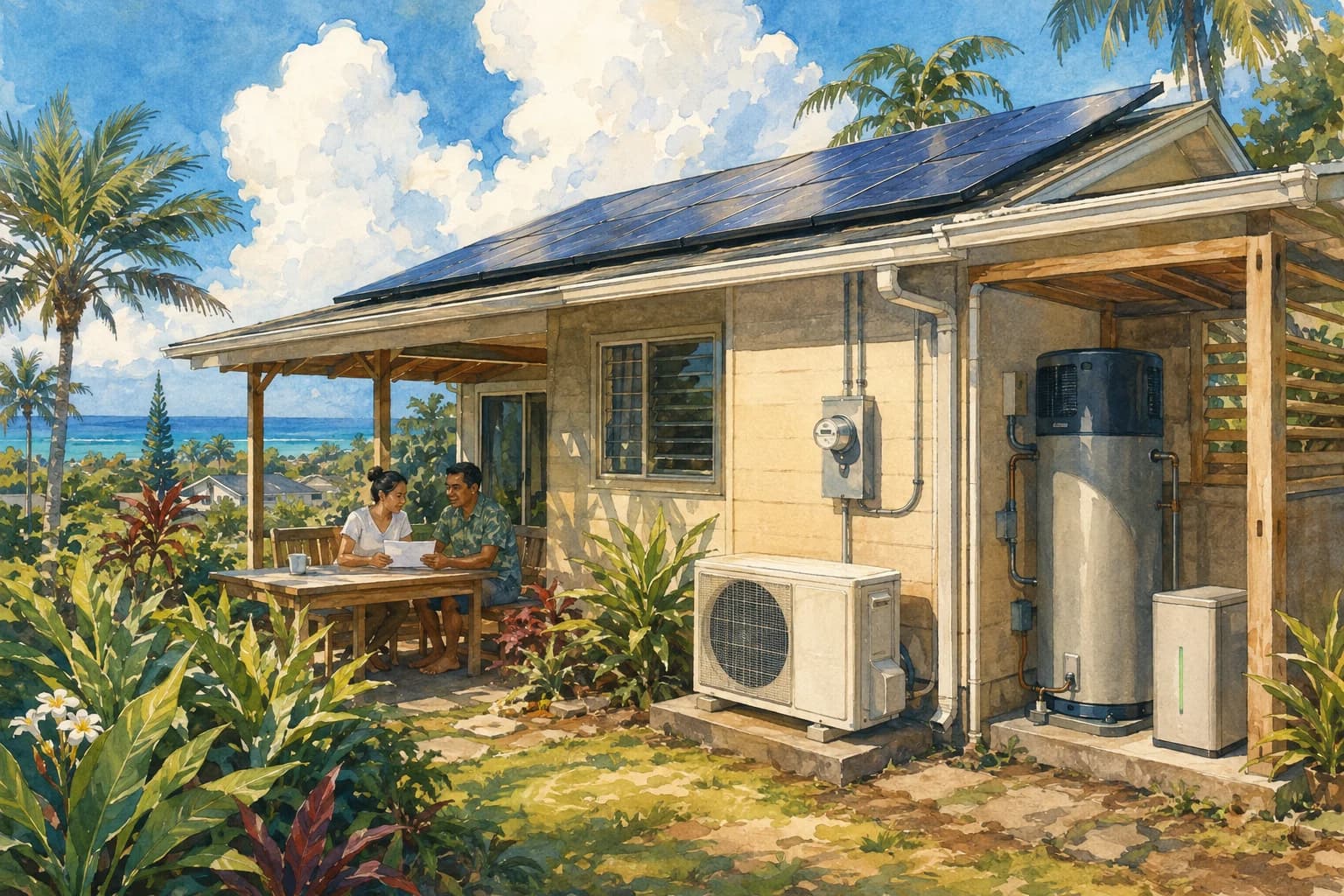
Hawaiʻi already has material pieces of an affordability program. The Green Energy Money $aver on-bill program offers meter-tied finance to qualifying customers and screens projects against estimated bill savings. The eHale Energy Saver program describes future home-electrification and efficiency rebates, but the State says it remains pending launch. The public need is a coordinated path that does not require households to assemble separate applications, estimates, and contractor obligations on their own.
PMF proposes a single customer offer with a baseline bill, installed measures, confirmed incentive amount, payment, conservative post-installation estimate, ownership and transfer terms, maintenance responsibility, warranty coverage, and complaint remedy. The offer should qualify projects with actual load data and an installation plan. It should not rely on unconfirmed tax credits, assumed battery dispatch revenue, or optimistic savings claims to make the numbers work.
The standard gives priority to low- and moderate-income households, renters where the program permits, affordable housing, and residents with clear essential-service needs. Efficient thermal equipment is not a luxury measure in this context: it supports indoor comfort, hot water, and lower electrical demand. Storage is added where the load study, site design, and customer need justify it.
Evidence and implementation
Implementation dossier: household comfort and resilience finance
A household upgrade should be financed as a transparent comfort-and-bill-improvement package, with capital, equipment ownership, and future grid value kept contractually separate.
Evidence reviewed September 7, 2026
Underwrite a real household outcome, not a projected program stack
Evidence & PMF analysisSource context & PMF recommendation
HGIA’s GEM$ on-bill program provides a useful starting point: meter-tied financing and an estimated-savings screen for qualifying customers. It is not a universal guarantee of bill savings or eligibility. PMF recommends that a Hawaiʻi offer calculate the customer’s payment from confirmed support, documented site conditions, conservative savings, and known maintenance—not future rebates, tax credits, or uncontracted VPP revenue.
Sources: GEM$ on-bill financing requirements (Hawaiʻi Green Infrastructure Authority)
Published terms · source context
The public SHARE offer illustrates why financial terms must be read in full. Its advertised equipment discount is not an all-in installed-price guarantee; its public FAQ says savings are not guaranteed and describes separate battery ownership and exit conditions. It is a useful disclosure precedent, not a Hawaiʻi program template or evidence of delivered savings.
Sources: SHARE offer, eligibility and FAQ (Rewiring America)SHARE launch announcement (PG&E)
Use one eligibility review and three understandable contracts
PMF recommendationPriority eligibility should consider income, bill burden, housing condition, essential-service needs, tenancy, electrical readiness, and customer choice. A program administrator may coordinate the work, but each household should receive three separable documents: an installation and maintenance agreement; a finance or service-payment agreement; and, only if chosen, a grid-services agreement. A customer can improve comfort without being compelled to enroll a device for dispatch.
For renters, the owner’s consent and the resident’s informed consent are both necessary, but neither should be used to create a rent increase or automatic transfer of debt. The offer should identify meter-transfer rules, move-out rights, equipment access, repair responsibility, tenant data access, and a neutral complaint route. Translated, accessible notices and a cooling-off period are basic consumer protections, not optional outreach.
Match ownership, security, and maintenance to the party that controls them
PMF recommendationThe capital stack should use only confirmed grants, rebates, and low-cost capital before calculating a payment. A reserve should cover commissioning failures, warranty disputes, meter or data errors, and provider insolvency. The program should require a conservative bill-savings buffer for priority households and a corrective process when measured results fall short. A household should not carry a loan balance caused by a contractor, manufacturer, or program-operator failure.
Storage ownership deserves its own disclosure. If a provider or equipment company retains a battery—as the public SHARE terms say Carrier retains its battery—the agreement should separately state ownership, insurance, lien or removal rights, monitoring, cybersecurity patching, maintenance response, data access, replacement, and end-of-term treatment. Those terms should never be obscured inside a heat-pump quote or an electricity-bill insert.
Sources: SHARE offer, eligibility and FAQ (Rewiring America)
Commission, measure, and release funds in stages
PMF recommendationBefore approval, collect baseline bills and, where consented to, interval data; verify equipment condition, panel and wiring needs, permits, scope, and customer goals. Release payment in milestones: approved design, code-compliant installation, commissioning, customer orientation, and a post-install follow-up. Payment to an installer should not be accelerated merely because equipment was delivered to a site.
A portfolio scorecard should report anonymized baseline and post-install bills, payment burden, comfort or hot-water satisfaction, outages where a resilience claim was made, warranty calls, cancellations, tenant outcomes, and any grid-service value that was actually contracted and delivered. Expansion is justified only when the independent review confirms affordability, safety, maintenance capacity, and complaint performance—not when a forecast model looks favorable.
Upfront support changes the monthly financing burden
An illustrative household budget. Equipment and bill amounts are assumptions; this is not a quote, savings guarantee or eligibility determination.
- Financed principal
- $12,000
- Monthly loan payment
- $98.05
- Monthly surplus
- $16.95
The illustrative underwriting test retains a $20 monthly savings buffer. This scenario is $3.05 below that buffer. Positive savings alone do not establish affordability or program eligibility.
| Budget item | Amount |
|---|---|
| Baseline electricity bill | $350.00 |
| Post-upgrade electricity bill | $230.00 |
| Loan payment | $98.05 |
| Maintenance reserve | $5.00 |
| Contracted grid revenue counted | $0.00 |
| Total post-upgrade monthly outlay | $333.05 |
| Baseline less post-upgrade outlay | $16.95 |
| Illustrative underwriting buffer | $20.00 |
| Surplus less underwriting buffer | -$3.05 |
Financing equation and assumptions
Installed cost is $18,000. Principal = $18,000 − upfront support. The assumed loan carries 5.5% APR over 15 years with 180 level monthly payments. Payment = P × i ÷ [1 − (1 + i)⁻¹⁸⁰], where P is principal and i = 0.055 ÷ 12.
Monthly surplus = $350 − $230 − payment − $5. At the initial $6,000 support assumption, $12,000 is financed. No grid revenue, unconfirmed tax credit or unopened rebate is counted. Fees, rate changes and replacement costs beyond the stated maintenance reserve are not modeled.
The $20 monthly buffer is an illustrative PMF underwriting assumption, not a published program eligibility rule. The initial scenario produces approximately $16.95 monthly surplus and falls approximately $3.05 below that buffer.
GEM$ provides financing context; its eligibility and savings tests still apply. The scenario does not establish a GEM$ offer or imply that eHale is open.
Source context · reviewed September 7, 2026
- GEM$ on-bill financing requirements — Hawaiʻi Green Infrastructure Authority. Eligibility, approved measures and estimated-savings tests apply.
- eHale Energy Saver Rebates — launch status — Hawaiʻi State Energy Office. Federal launch approval remains a dependency; not an open rebate assumption.
- Homegrown Energy technical methodology — Rewiring America. Housing, equipment, capital-cost, financing and rate assumptions constrain transferability.