
Policy · Hawaiʻi
Analysis
Hawaiʻi’s home batteries are installed. The aggregator seat is open.
The Public Utilities Commission is redesigning how the state pays customer batteries for evening service. The last company to sit between those batteries and the utility failed in 2024, and the new rules will decide who carries that risk next time.
September 17, 2026 · 8 min read
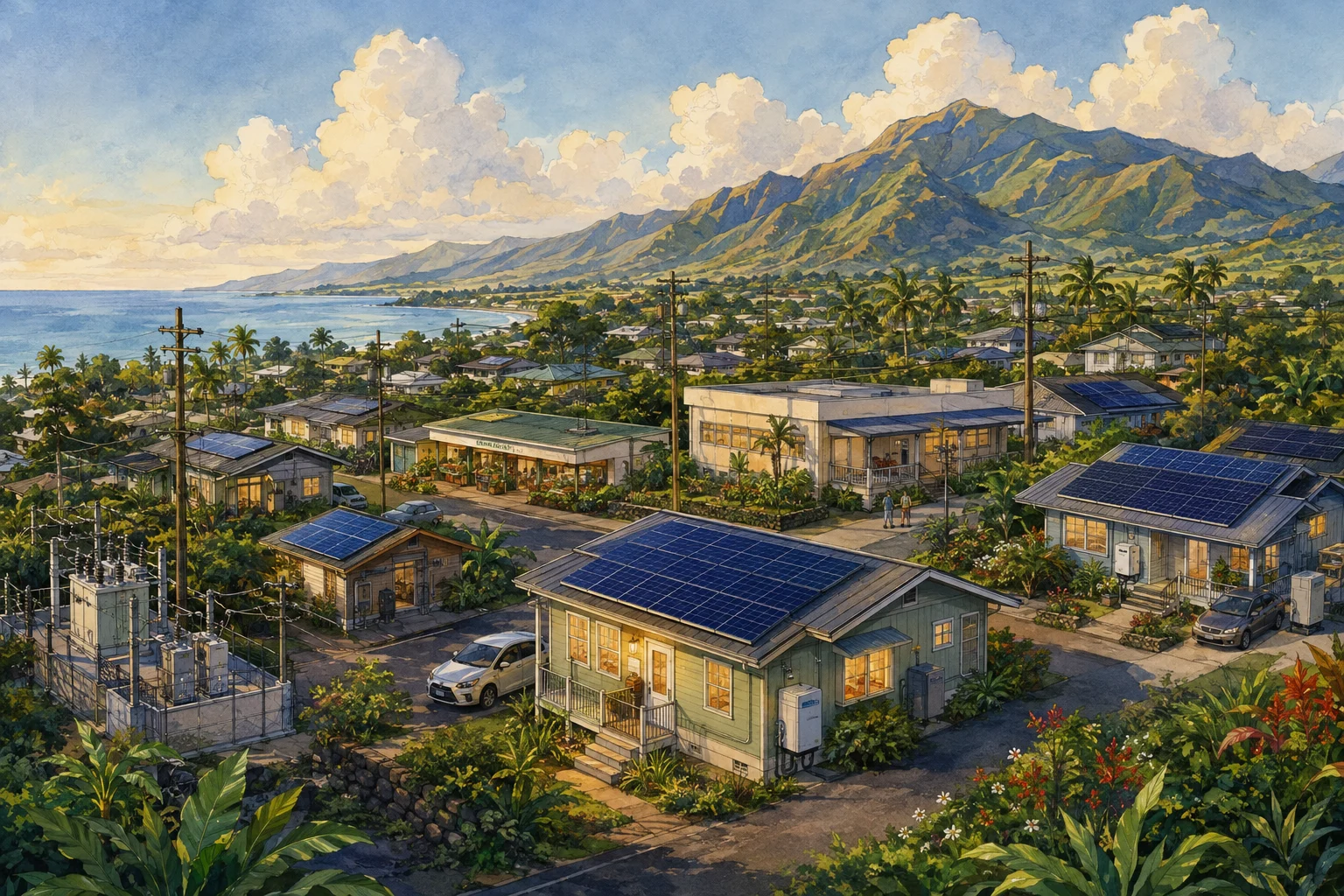
In late September 2024, about 1,200 households on Oʻahu, Maui and Hawaiʻi Island got the same news. The company that had enrolled their home batteries in a grid program, and that stood between them and Hawaiian Electric, had stopped operating. The utility’s notice said Swell Energy had “closed its doors.”
The batteries were still on the garage walls. They still charged from rooftop solar at noon and could still discharge at 7 p.m. What disappeared was the contract that told them when to do it, and the company that was supposed to handle the money.
Two years later, the Public Utilities Commission is rebuilding that arrangement. Docket No. 2026-0084, opened on April 22, 2026, is meant to redesign the programs that pay customers for their batteries’ service to the grid. At its center is the question Swell’s collapse raised and did not settle: who sits between a household’s battery and the utility, and what happens to the household when that party fails.
A fleet without a dispatcher
Hardware is not the scarce part. When the Legislature passed Act 266 in 2025, its findings recorded that 96 percent of residential rooftop solar installations in the state now include storage, and that nearly half of Hawaiian Electric’s 36.7 percent renewable share as of September 2024 came from customer rooftops. The utility counted 120,570 rooftop solar systems at the end of 2025, on about 45 percent of the single-family homes it serves.
Most of that equipment answers to its owner, not the grid. A battery told to export for two hours at the evening peak helps the system far more than one that only runs its own home, but only if someone sends the signal, counts the kilowatt-hours and pays for them. The commission said as much when it opened the docket.
The commission found that while Hawaiʻi has one of the highest levels of distributed energy resource adoption in the nation, many of these resources are not optimized to support grid reliability or reduce reliance on fossil fuels.— Hawaiʻi Public Utilities Commission, press release opening Docket No. 2026-0084, April 22, 2026
Its initial guidance pointed to a remote-dispatch model, performance-based compensation and wider access for low- and moderate-income households. A technical conference followed on June 16, 2026.
What the programs paid
Hawaiian Electric has run two generations of these programs. Battery Bonus, which paid a cash incentive and bill credits to customers who added storage to rooftop solar, reached its 40-megawatt cap on Oʻahu in December 2023; it also enrolled 6 megawatts on Maui, by the Act 266 findings.
Hawaiian Electric’s current offer is Bring Your Own Device Plus. Its terms, from the utility’s program page: $400 per kilowatt committed, paid up front with no maximum; an export window of two hours every day, chosen by the customer; and a five-year commitment. Low- and moderate-income households can receive a second $400 per kilowatt.
The utility’s worked example is a household with a 15-kilowatt-hour battery that commits 5 kilowatts for two hours, or 10 kilowatt-hours a day. That earns $2,000 up front and, the page says, an average export credit of about $52 a month.
Run it over the full term. Sixty months at $52 is $3,120; add the $2,000 and the household receives $5,120 over five years. At 10 kilowatt-hours a day it delivers about 18,250 kilowatt-hours in that time. That is roughly 28 cents for each kilowatt-hour delivered in the evening window, or about $1,024 per committed kilowatt, some $205 per kilowatt per year.
Whether that is a good deal for the household depends on what the battery would otherwise do. The monthly credit alone works out to about 17 cents per exported kilowatt-hour. The same kilowatt-hour used at home would have displaced purchases at Hawaiian Electric’s 2025 average Oʻahu residential price of 40.54 cents, and the Shift and Save time-of-use pilot charged 44.96 cents from 5 to 9 p.m. The offer works best for households whose batteries hold more than they use in an evening.
What Swell’s collapse showed
Swell ran a Home Battery Rewards program for Hawaiian Electric customers. When it failed, the utility said on September 26, 2024, that it would pay customers the up-front incentives the insolvent company owed them. It also paused the program’s monthly credits.
Hawaiian Electric will pause monthly credits starting in October and work with customers to unenroll their systems from the program so they can have better control over their energy resources.— Hawaiian Electric, news release, September 26, 2024
Yoh Kawanami, a co-director of the utility’s Customer Energy Resources group, said in the same release: “This situation is unprecedented and we appreciate customers' patience and understanding as we work toward a positive resolution.”
Three lessons follow, and none of them is about batteries. The household’s enrollment ran through a private company, so when the company failed, the enrollment failed with it. Money owed to customers sat with the same company until the utility stepped in. And there was no ready way to move enrolled batteries to another operator; the remedy was to unenroll them, taking capacity off the evening peak.
Act 266 makes the aggregator’s role larger. The law requires tariffs that let aggregators join grid-service programs, automatically enroll and manage their customers, receive dispatch signals from the utility, deliver measurement data and receive program payments directly from the utility. It also requires battery performance to be measured at the device, without an extra meter. That lowers the cost of running a fleet and puts more of a household’s money and control in a third party’s hands.
What a fair tariff pays for
The statute is specific about what the payments are for.
These mechanisms must include sufficiently valued crediting for exported energy as a minimum customer protection and capacity and performance payments for the provision of grid services by distributed energy resources and virtual power plants.— Hawaiʻi State Legislature, Act 266 (SB 589), Section 1 findings, July 2, 2025
Read against the Swell record, that points to a tariff with four parts, priced separately so each can be checked:
- Capacity. A monthly payment for each kilowatt available at the evening peak, because that is what a system planner counts.
- Energy at the hour. An export credit tied to the value of a kilowatt-hour between 5 and 9 p.m., when Oʻahu leans on its oil-fired plants.
- Performance. Payment that rises and falls with delivery measured at the device, so a fleet that does not show up is not paid as if it had.
- Location. A premium where batteries relieve a specific constrained feeder, which is where customer storage is most clearly cheaper than the alternative.
It also points to three protections. Enrollment should move with the customer to another approved aggregator if the first one exits. Program payments should be held apart from an aggregator’s operating funds or paid by the utility straight to the household. And the utility should keep dispatching enrolled batteries at the tariff rate during any transition. These are contract terms, not technologies, and the new law gives the commission room to require them.
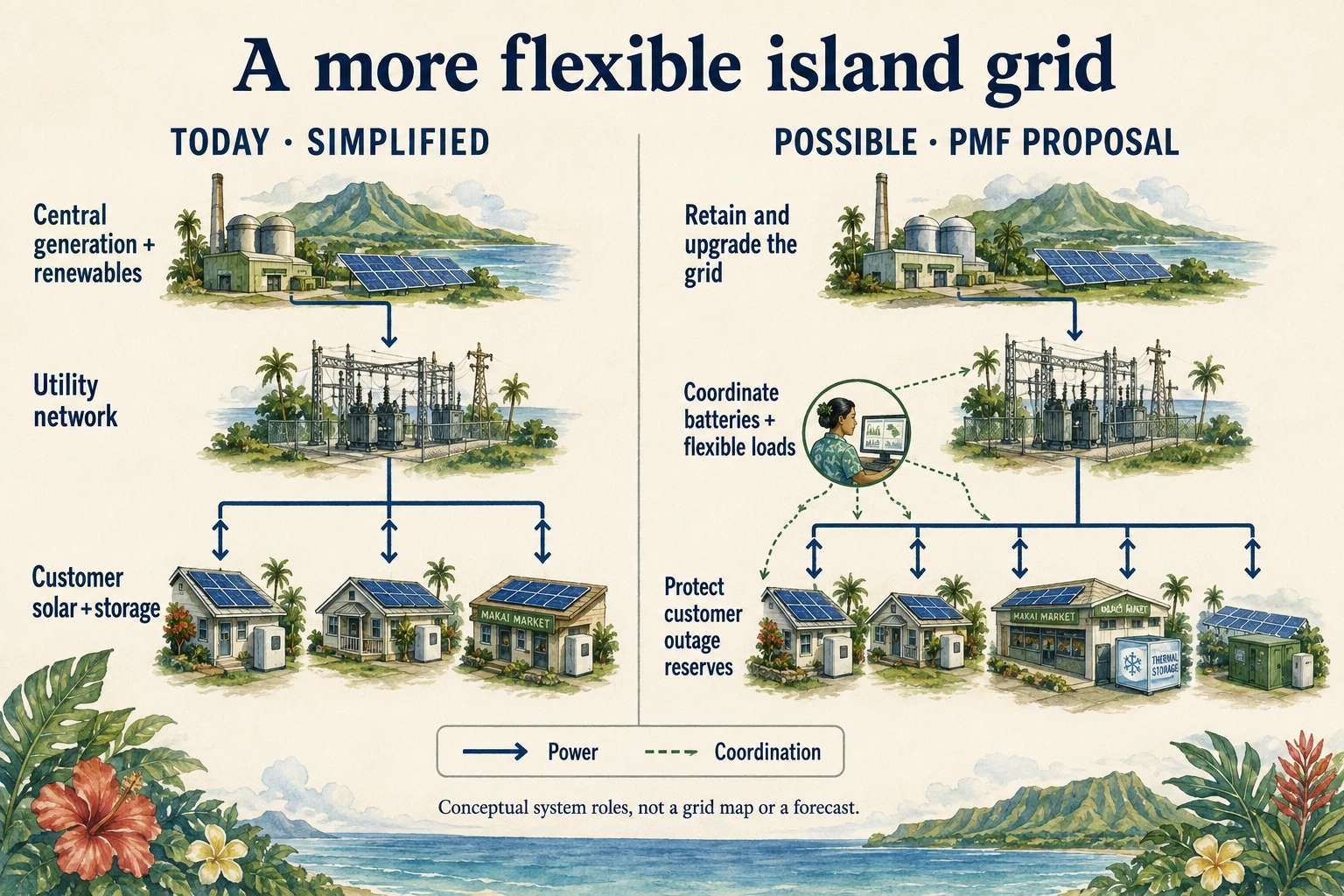
The location point is easiest to see on a single feeder. The Federation’s model includes an illustrative study of Kailua: 1,675 homes, 231 multifamily buildings and 266 commercial accounts on one corridor, plus an illustrative 30-megawatt campus load. The campus figure is an assumption for the study, not the metered demand of any facility, and the study is not a utility plan.
The figures come from Airform’s open grid model, re-run on this page; Airform, which makes heat-pump and battery equipment, publishes the assumptions at airformdata.com.
On the model’s design day, demand on the corridor exceeds what the local wires can carry by as much as 13.3 megawatts, over about six and a half hours, leaving 19.9 megawatt-hours unserved. A coordinated fleet of customer batteries in the same neighborhood supplies 16 megawatts of firm capacity and 27.4 megawatt-hours. Move the slider to change how many households take part and watch the shortfall close or reopen.
The model then prices two ways of closing that gap. A customer-financed fleet costs about $15.2 million, roughly $950 per kilowatt of firm capacity. Conventional utility upgrades cost about $69.2 million, or $5,205 per kilowatt, and take about six years. Both are modeled estimates for one illustrative corridor, and the utility figure includes wires work that batteries cannot replace everywhere.
The BYOD Plus arithmetic above, about $1,024 per committed kilowatt over five years, lands near the model’s fleet number, though one pays for service from batteries customers already own and the other is the fleet’s capital cost.
Scale is the other test. If 20,000 households each committed 5 kilowatts on the terms of Hawaiian Electric’s example, they would offer 100 megawatts for two hours each evening. That is about 29 percent of the 350 megawatts of grid-forming capacity Hawaiian Electric was cleared in August 2026 to seek on Oʻahu, though a two-hour customer commitment is not a like-for-like substitute. It would take about one in six of the rooftop systems the utility counted at the end of 2025. Change the inputs below to compare the two builds.
The case against
The strongest objection is about who pays. Program payments are recovered from all customers, including renters and condo owners who cannot install solar or storage. A tariff generous enough to fill the fleet can move costs onto households with no way to join it, which is why the commission’s guidance singled out low- and moderate-income participation.
The second objection is reliability. A utility-scale battery answers to one operator. A household battery may already be drained after a storm, when the system needs it most, and an aggregator’s fleet is only as dependable as its contracts and communications. Planners discount customer resources for those reasons, and they are not wrong to.
Both objections argue for careful design, not against a tariff. Paying for measured performance answers part of the reliability concern; pricing capacity at what it displaces, with a locational premium only where wires are constrained, limits the cost shift.
The batteries are installed, and more arrive with nearly every new rooftop system. What the commission is writing now is the part Swell’s customers found missing: a contract that survives the company holding it.
The seat is open. The tariff decides who can sit in it, and what happens to the households when they leave.
Read next

Grid · Hawaiʻi · October 2, 2026
The Evening PeakOʻahu’s 7 p.m. problem: the sun sets and oil carries the evening
Rooftop solar fills the middle of the day. When it fades, Oʻahu still turns to oil. What the utility is buying for the 2030s, what customer batteries can carry now, and what they…

Policy · Hawaiʻi · September 24, 2026
ExplainerThe PUC owes Hawaiʻi wheeling and microgrid rules by Jan. 1, 2027
Act 266 lets a renewable project of 100 kilowatts to 2 megawatts sell power across Hawaiian Electric’s wires to another customer. The commission has a straw proposal, a technical…

Markets · Hawaiʻi · California · September 11, 2026
AnalysisWhat California’s energy fights can teach Hawaiʻi, and what they can’t
California has more than 21,000 megawatts of batteries and some of the country’s steepest rate increases. Its export tariff, wildfire bills and connection deadlines give Hawaiʻi a…