
Grid · Hawaiʻi
The Evening Peak
Oʻahu’s 7 p.m. problem: the sun sets and oil carries the evening
Rooftop solar fills the middle of the day. When it fades, Oʻahu still turns to oil. What the utility is buying for the 2030s, what customer batteries can carry now, and what they cannot.
October 2, 2026 · 7 min read

On Sept. 1, 2022, the AES Hawaiʻi coal plant at Barbers Point stopped operating, 30 years to the day after it opened. AES says the plant had supplied up to 20% of Oʻahu’s energy. That morning Hawaiian Electric told customers their bills would rise less than it had feared; its earlier forecast had been an increase of 7%, or about $15, once the plant closed.
Four years later, the hardest hour on Oʻahu’s grid is not a question of baseload. It is the evening. Around 7 p.m., rooftop solar has faded, air conditioners and stoves are running, and the island turns to the plants it has always turned to: oil-fired steam units and combustion turbines.
This is the 7 p.m. problem. It explains why Oʻahu’s renewable share trails the other islands, why the Public Utilities Commission approved new turbines at Waiau this year, and what customer batteries can and cannot do about either.
The shape of the day
Hawaiian Electric counted 120,570 rooftop solar systems on its grids at the end of 2025, on about 45% of the single-family homes it serves. At midday those panels, with the island’s solar farms, carry much of Oʻahu’s load. The utility also reported that demand grew 2.5% in 2025, the largest year-over-year rise since 2004.
Oʻahu imports no electricity. Every kilowatt-hour used after sunset has to come from a plant on the island or from storage charged earlier in the day. The Federation’s city model, built on Airform’s open data, puts a late-summer design-day peak at about 1,180 megawatts, reached at 7 p.m. It is a modeled day, not a metered one, but its shape is the one the utility plans around: a trough at noon and a steep climb after 5.
The plants that meet that climb are old. In the public plant inventory the model draws on, Kahe is listed at 610 megawatts, with an average commissioning year of 1972; Waiau at 475 megawatts, averaging 1963; the Kalaeloa cogeneration plant at 299 megawatts from 1990; and a 113-megawatt combustion turbine at Campbell Industrial Park from 2009. The inventory classifies 1,529 of the island’s 2,266 megawatts as oil-fired, about two-thirds of nameplate capacity.
The record
Hawaiian Electric’s renewable portfolio standard report for 2025, filed with the commission in February, puts the utility’s consolidated figure at 36.8% of generation. The islands are far apart: Hawaiʻi Island reached 57.3%, Maui County 41.6% and Oʻahu 32.3%. Measured against sales rather than generation, the consolidated figure is 46.6%.
State law sets the standard at 40% of net generation by the end of 2030, 70% by 2040 and 100% by 2045. On the generation measure the utility is 3.2 points short of the 2030 mark, with a little over five years to close the gap. That sounds small. But load is growing, so new renewable output must first cover the growth before it moves the percentage, and Oʻahu, the most populous island, is the one pulling the average down.
Hawaiian Electric expects four projects due in 2026, Hale Kuawehi, Hoʻohana Solar 1, Mountain View Solar and Waiawa Phase 2, 119 megawatts in all, to add about two points.
What the utility is buying
The 185-megawatt Kapolei Energy Storage facility, owned by Plus Power, came online in 2023 and is the island’s largest battery. It moves midday solar into the evening at grid scale.
The next piece is firm generation. In March the commission approved Hawaiian Electric’s plan to repower Waiau, and described the project this way:
The project proposes to replace six aging, inflexible oil-fired steam units with six new fuel-flexible, simple-cycle combustion turbines totaling 253 megawatts.— Hawaiʻi Public Utilities Commission, news release, March 23, 2026
The commission capped cost recovery at the utility’s original competitive bid of $847 million, plus a limited inflation adjustment, and put the effect on a typical Oʻahu residential bill at about $3.62 a month. Divided by 253 megawatts, the cap works out to roughly $3,350 per kilowatt of capacity.
The approval came with fuel conditions. The new units must run on at least 51% renewable fuel at commissioning of the first four units or by 2032, whichever comes first, rising to 75% by 2040 and 100% by 2045. Whether that much renewable fuel can be bought, and at what price, is a question the order leaves to the years ahead.
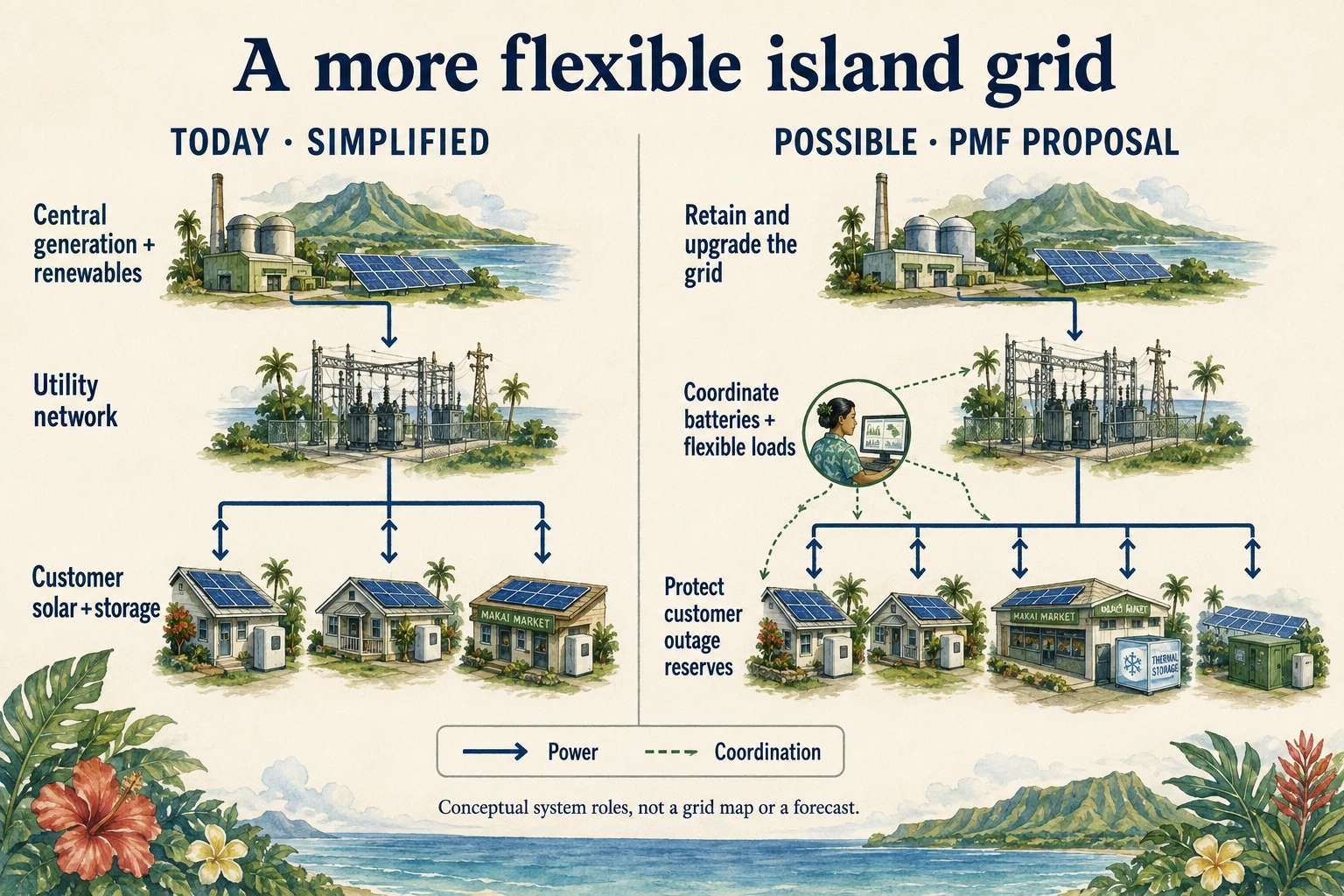
On July 17, Hawaiian Electric asked the commission to approve an expedited procurement: about 1,650 gigawatt-hours a year of variable renewable energy, 465 megawatts of grid-forming solar-plus-storage and 111 megawatts of firm capacity across Oʻahu, Hawaiʻi Island and Maui, in service between 2031 and 2034. The same release said the utility was also seeking 500 megawatts of additional fuel-flexible firm generation for Oʻahu.
For scale: at the 6,500 kilowatt-hours a year the Federation’s model assigns an Oʻahu household, 1,650 gigawatt-hours is roughly what 250,000 homes use in a year.
We believe natural gas could be a beneficial option for Hawaii if it can deliver value to our customers.— Scott Seu, CEO, Hawaiian Electric, July 17, 2026
The commission approved the requests for proposals in August. The Honolulu Star-Advertiser reported Oʻahu’s share as 350 megawatts of grid-forming resources and 81 megawatts of firm capacity, with projects to be selected in September 2027.
The competitive bidding process has proven to be the most effective means to fairly evaluate projects and ensure our customers' interests are protected.— Shelee Kimura, President, Hawaiian Electric, August 10, 2026
Every resource on that list is utility-scale and arrives in the 2030s. The evenings between now and then run on what is already on the island, plus whatever customers add behind their meters.
What customer batteries can do
Customers are already adding storage. Act 266, signed in July 2025, records in its findings that 96% of residential rooftop solar installations in the state now include a battery, and that the Battery Bonus program enrolled 40 megawatts on Oʻahu. Its successor, Bring Your Own Device Plus, pays $400 per kilowatt committed up front in exchange for a two-hour export window, chosen by the customer, every day for five years.
What that capacity is worth depends on what it replaces. The Federation’s city model runs the late-summer design day three ways. In the first, the island runs as it does now. In the second, 35% of homes add air conditioning with ordinary equipment: the evening peak rises to about 1,301 megawatts and output from oil peakers nearly triples, from 334 to 978 megawatt-hours over the day. In the third, the same cooling arrives as 105,000 battery-integrated heat pumps, a quarter of the island’s room units, each holding 5 kilowatt-hours charged from the midday sun.
In that third case the peak lands at about 1,188 megawatts, close to today’s, and peaker output falls to 447 megawatt-hours. The relief against ordinary cooling is about 114 megawatts, a little under two-thirds of the 180 megawatts the model uses as its yardstick for the coal plant Oʻahu closed in 2022. Move the sliders to change adoption, battery size and how many homes add cooling.
The figures come from Airform's open grid model, re-run on this page; Airform, which makes heat-pump and battery equipment, publishes the assumptions at airformdata.com.
What they cannot do
The same run shows the limits. With batteries, the island still burns more peaker fuel than it does today, 447 megawatt-hours against 334, and the model’s daily carbon dioxide figure is 11,766 tonnes, against 10,630 today and 12,512 with ordinary cooling. A fleet of customer batteries holds the line against new load. It does not by itself retire oil.
It also runs out. The model discharges the fleet between 5 and 9 p.m.; after that, the night belongs to the steam plants. The grid model shows the same constraint on a single corridor. In Kailua, it places an illustrative 30-megawatt campus load, standing in for Marine Corps Base Hawaiʻi, on the same lines as the town. On a stressed evening the corridor falls short by as much as 13.3 megawatts, across a window of six and a half hours.
The town’s customer fleet can deliver 16 megawatts, more than the worst gap. But it holds only 27.4 megawatt-hours, under two hours at full output, so it covers about 55% of the shortfall. Power is not the binding limit. Duration is.
The case for firm power
That is the honest comparison with Waiau. The model puts the Kailua fleet at about $950 per firm kilowatt, against roughly $3,350 per kilowatt under the Waiau cap. But a turbine can run for days on delivered fuel. A two-hour battery cannot, and a run of cloudy days would leave it short of charge.
The strongest argument for the turbines is reliability planning. A grid operator has to meet the worst evening of the year with resources it controls. Customer batteries are owned by households, enrolled voluntarily and reserved partly for their owners’ backup. Aggregators can fail: Swell Energy closed in September 2024, leaving about 1,200 Hawaiian Electric customers in its battery program, and the utility paused their monthly credits while it unenrolled their systems.
None of that argues against batteries. It argues for contracts that make customer capacity as dependable as a plant. In April the commission opened a docket on virtual power plants and pointed toward remote dispatch, performance-based compensation and access for low- and moderate-income households. Those terms will decide how much of the evening customers can be trusted to carry.
Oʻahu retired its coal plant on a single morning. The oil evening will not end that way. If it ends, it will end an hour at a time, starting with the four between 5 and 9 p.m.
Read next
Markets · Hawaiʻi · California · September 24, 2026
AnalysisHawaiʻi’s electricity hit 52.72 cents in June, nearly triple the U.S. average
Federal data put the state’s residential price up almost 29% in a year, and oil explains the swing. California’s high prices have a different cause. The hour of use is the one par…
Policy · Hawaiʻi · September 17, 2026
AnalysisHawaiʻi’s home batteries are installed. The aggregator seat is open.
The Public Utilities Commission is redesigning how the state pays customer batteries for evening service. The last company to sit between those batteries and the utility failed in…

Markets · Hawaiʻi · California · September 11, 2026
AnalysisWhat California’s energy fights can teach Hawaiʻi, and what they can’t
California has more than 21,000 megawatts of batteries and some of the country’s steepest rate increases. Its export tariff, wildfire bills and connection deadlines give Hawaiʻi a…