
Policy · Hawaiʻi
Explainer
The PUC owes Hawaiʻi wheeling and microgrid rules by Jan. 1, 2027
Act 266 lets a renewable project of 100 kilowatts to 2 megawatts sell power across Hawaiian Electric’s wires to another customer. The commission has a straw proposal, a technical conference record and 99 days to turn them into rules.
September 24, 2026 · 6 min read

Since July 1, 2024, Hawaiian Electric has had a formal plan to switch off power to parts of its system when wind and dry conditions raise the risk of fire. The areas covered when the Public Safety Power Shutoff program began held about 48,100 customers, more than half of them in Maui County.
For those customers, resilience has a specific meaning: a building that can keep its own refrigeration and lights running when the line is cut, or a nearby solar array that can sell it power when the line is up. The Legislature wrote both ideas into Act 266 in 2025. It gave the Public Utilities Commission until January 1, 2027, to set the rules.
As of this story’s publication, that is 99 days away, and this newsroom has found no final order in the docket.
What the law says
The deadline is in a new section of the state’s utility law, §269-D.
No later than January 1, 2027, the public utilities commission shall establish, by rule or order, policies and procedures to implement wheeling and microgrid service tariffs that include appropriate charges for wheeling participants and any consumer protection measures the commission deems necessary …— Hawaiʻi State Legislature, Act 266 (SB 589), new HRS §269-D(b), July 2, 2025
The sentence goes on to limit eligible wheeling projects to between 100 kilowatts and 2 megawatts of alternating-current capacity. Another subsection restricts wheeling to renewable electricity. The Act defines wheeling as moving renewable power from a storage or generation system through the utility meter for use by a separate account holder: a school’s solar canopy selling to the clinic across the street, for example, over wires the utility still owns.
The Act also says that a person who builds or runs a new microgrid is not a public utility solely because it serves the consumers participating in it. Both provisions exclude member-owned cooperatives, which leaves out the Kauaʻi Island Utility Cooperative. The Act was approved on July 2, 2025, which gave the commission 18 months.
Where the docket stands
The work is happening in Docket No. 2024-0200. According to the commission’s docket page, it runs on two tracks: retail wheeling under Act 266, and a separate state and county shared-credit program. Hawaiian Electric filed a Retail Wheeling Straw Proposal on November 10, 2025, and its response to stakeholder comments on March 6, 2026.
The commission then held a technical conference on April 7, 2026, to “review the current record on Hawaiian Electric's Retail Wheeling Straw Proposal, discuss stakeholder feedback, and identify the additional steps needed to develop a strong and effective retail wheeling program.” The commission’s docket page listed no tariff when this story was prepared.
Microgrids are not starting from zero. Under an earlier law, Act 200, the commission approved a Microgrid Services Tariff in May 2021 in Docket No. 2018-0163. Act 266 asks for policies covering microgrid tariffs alongside wheeling, so the question for January is whether the commission revises that framework or leaves it largely in place.
The resilience case
The case for local power on Maui rests on a record nobody wanted. After the August 8, 2023 wildfires, the defendants agreed to pay more than $4 billion to resolve the tort claims.
HEI and Hawaiian Electric's contribution is a total of $1.99 billion (pre-tax) and includes the $75 million previously contributed for the One ʻOhana Initiative, to be paid in four installments.— Hawaiian Electric Industries, press release filed with the SEC, August 2, 2024
That is roughly half the total. The shutoff program is one of the utility’s responses to the same risk.
Wildfires have been recognized as a top hazard facing Hawaii. Hawaiian Electric has responded with a multi-pronged approach to mitigating wildfire risk.— Jim Alberts, Senior Vice President and Chief Operations Officer, Hawaiian Electric, May 29, 2024
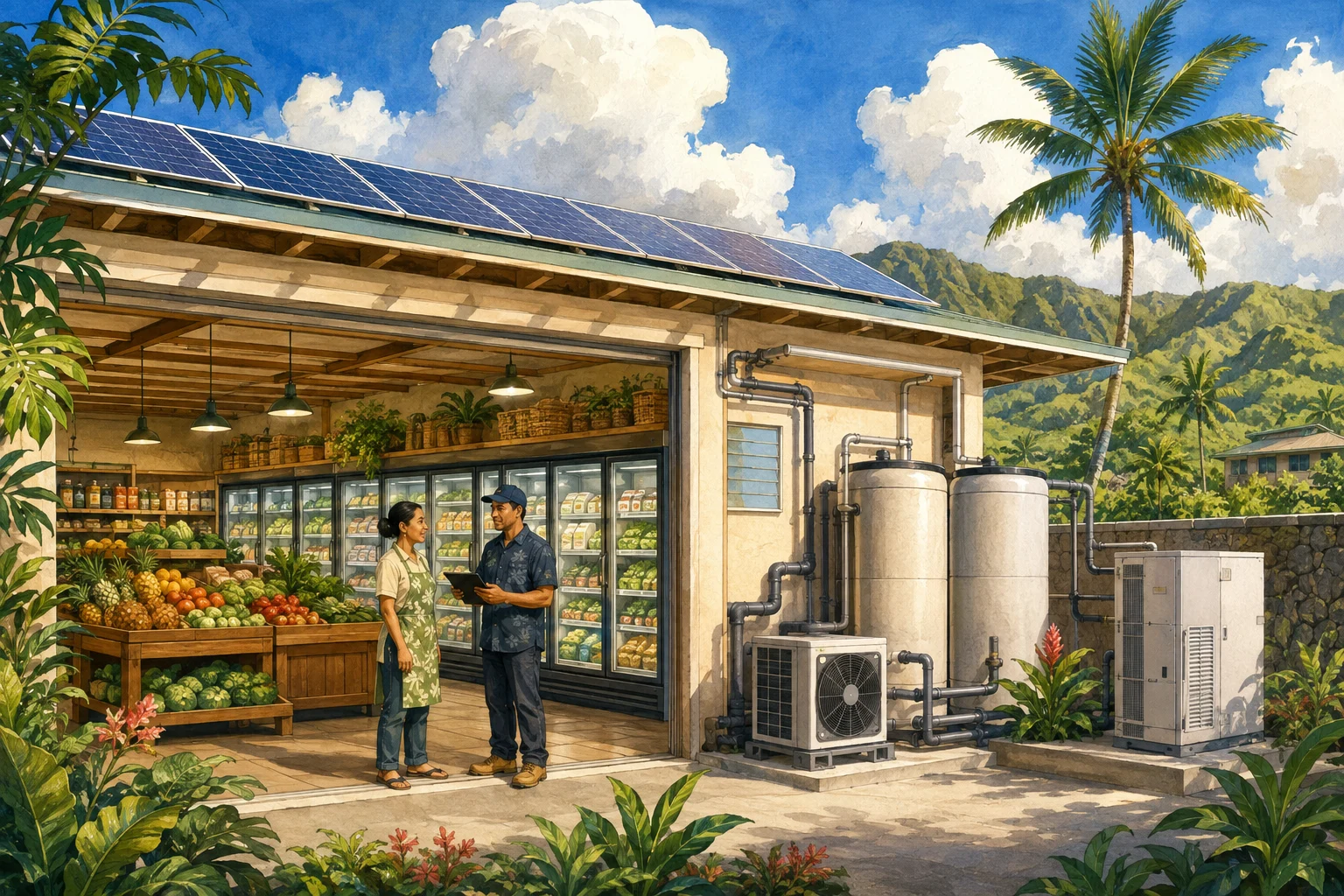
A shutoff protects against ignition by taking service away, and the cost falls on the customers in the shutoff area. A microgrid that can island a grocery, a clinic or a water pump during that window gives some of the service back. Wheeling lets a neighborhood array of up to 2 megawatts sell to those buildings the rest of the year, which helps pay for the batteries that carry them through the outage.
The same batteries that carry a building through an outage also shrink what it draws from the grid on an ordinary day. The Federation’s model of an eight-storey building in Hawaiʻi shows the effect on its electrical service. Built conventionally, the building needs about 188 kilowatts of capacity, an 800-amp service at 208 volts, at a modeled cost of $226,500. With batteries managing its peak, it needs about 96 kilowatts on a 400-amp service, for $183,000.
The figures come from Airform’s open grid model, re-run on this page; Airform, which makes heat-pump and battery equipment, publishes the assumptions at airformdata.com.
That is a peak about 49 percent lower and $43,500 less in electrical work, before counting any value from riding through a shutoff. Compare the two services in the panel below.
The price of the wires
The hardest part of the January order is not eligibility. It is the charge. The statute requires “appropriate charges for wheeling participants,” and the size of that charge decides whether anyone uses the law.
Take an Oʻahu buyer paying Hawaiian Electric’s 2025 average residential price of 40.54 cents per kilowatt-hour; commercial rates differ, but the residential average is a useful reference. As a stand-in for what a seller might accept, use the 15-cent subscriber credit the commission set for small shared-solar projects on Oʻahu in Phase 2 of its Community-Based Renewable Energy program. That leaves about 25.5 cents per kilowatt-hour to divide among the wheeling charge, the seller’s margin and the buyer’s savings. A 15-cent charge leaves about 10 cents to share; a 25-cent charge leaves almost nothing.
The Federation’s model assumes 8 cents per kilowatt-hour of margin for stored solar sold across the wires to a commercial buyer, and keeps that revenue switched off until a tariff exists.
The strongest objection comes from customers who will never wheel. Poles, wires, wildfire mitigation and standby generation are paid for through rates. If a wheeling customer pays less than its share of those costs, everyone else pays the difference. A charge that ignores that will shift costs; a charge that loads every fixed cost onto a 1-megawatt project will mean nothing gets built. The commission’s job in the next 99 days is to find the number between those two outcomes and show its work.
Microgrids and wheeling are one way to pay for local capacity; utility construction is the other. On the model’s illustrative Kailua corridor, where an illustrative campus load pushes evening demand past what the wires can carry, a customer-financed fleet of batteries costs about $15.2 million, roughly $950 per kilowatt of firm capacity. Conventional upgrades cost about $69.2 million, or $5,205 per kilowatt, and take about six years.
Those are modeled figures for one corridor, not a utility estimate, and a feeder upgrade buys things a battery fleet does not, including decades of wire life. But they show the size of the gap the January tariff is pricing. Adjust the fleet below to see how the comparison moves.
What to watch
- The order itself. Whether the commission issues rules by January 1, 2027, or an interim order with a schedule.
- The charge. Whether wheeling participants pay per kilowatt-hour, per kilowatt of capacity, a standby fee or some mix, and how each is justified.
- Consumer protections. The statute leaves these to the commission. Buyers of wheeled power will need clear contracts and a path back to utility service.
- Microgrid terms. Whether the 2021 tariff is revised to fit the Act’s new treatment of microgrid operators.
- Where projects go first. Whether shutoff areas, where local supply has the clearest value, get any priority.
The deadline is in the statute. The price of the wires is not, and that is the number that will decide whether anyone uses the law.
Read next
Policy · Hawaiʻi · September 17, 2026
AnalysisHawaiʻi’s home batteries are installed. The aggregator seat is open.
The Public Utilities Commission is redesigning how the state pays customer batteries for evening service. The last company to sit between those batteries and the utility failed in…

Grid · Hawaiʻi · October 2, 2026
The Evening PeakOʻahu’s 7 p.m. problem: the sun sets and oil carries the evening
Rooftop solar fills the middle of the day. When it fades, Oʻahu still turns to oil. What the utility is buying for the 2030s, what customer batteries can carry now, and what they…

Commentary · Hawaiʻi · October 1, 2026
CommentaryHawaiʻi cannot import its way to 2045
The state ships in the fuel, the equipment and, increasingly, the skilled labor its energy plan depends on. The part it can most realistically keep at home is the work of assembli…