
Labor · Hawaiʻi
Analysis
Hawaiʻi’s energy goals run through 3,070 electricians and 1,300 HVAC techs
The governor’s goal is 50,000 distributed energy installations by 2030. The licensed trades that would do the work are small, well paid and barely growing. The Federation’s model shows where an installation’s hours go, and how many could be cut.
September 29, 2026 · 6 min read
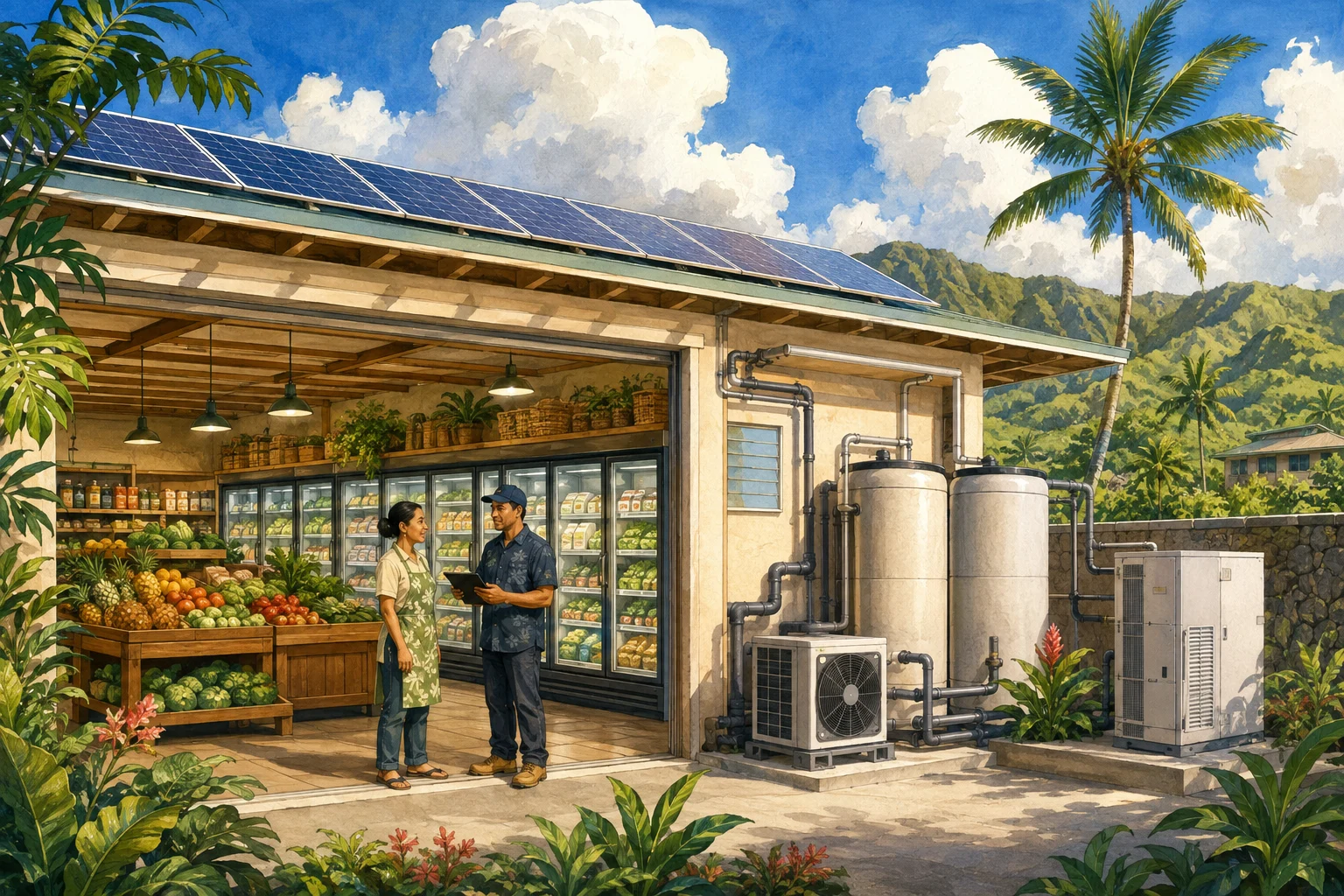
At the State Apprenticeship Council’s meeting on Dec. 10, 2024, the Workforce Development Division reported 5,406 registered apprentices in Hawaiʻi as of the day before. Its figures for the year ending Sept. 30, 2024, told a flatter story than the headline. The state registered or reinstated 1,621 apprentices. It also recorded 1,119 cancellations and 496 completions.
Add those up and the pool ended the year about where it began: 1,621 in, 1,615 out. For every apprentice who completed a program, more than two left without finishing. The figures cover every registered trade, from carpenters to electricians, and the minutes do not break them out.
The same meeting took up revisions to the Hawaii Electricians Training Fund’s wireperson apprenticeship standards, opening direct entry to applicants who completed an electricity or electronics program of at least 240 hours and to veterans from Defense Department SkillBridge programs. It was a small, practical step. The question here is whether steps of that size match the goals the state has set.
The goal
On Jan. 29, 2025, Gov. Josh Green issued Executive Order 25-01. The State Energy Office’s release described it as setting a statewide goal of 50,000 distributed renewable energy installations, “such as rooftop solar and battery systems,” by 2030.
Hawaiʻi needs to take some drastic steps to reduce energy costs, which have continued to rise and have contributed to the high cost of living for our people.— Josh Green, Governor of Hawaiʻi, in a Hawaiʻi State Energy Office release, January 29, 2025
The 50,000 figure is the governor’s. Act 266, the 2025 energy law, does not set a number; it directs the commission to set one:
The public utilities commission shall establish a goal for new customer-sited distributed energy resources, to be installed in the State by December 31, 2030.— Act 266, Session Laws of Hawaiʻi 2025, approved July 2, 2025
Spread over the six calendar years from 2025 through 2030, 50,000 installations is about 8,300 a year. For scale, Hawaiian Electric counted 120,570 rooftop solar systems on its grids at the end of 2025; 50,000 more would equal about 41% of that total, though the governor’s goal also counts Kauaʻi, which Hawaiian Electric does not serve. Nearly every new rooftop system now comes with storage: Act 266’s findings put the share of residential solar installations that include a battery at 96%.
The workforce on paper
Federal wage surveys give the size of the trades that do this work. The Bureau of Labor Statistics’ Occupational Employment and Wage Statistics for May 2025 count 3,070 electricians in Hawaiʻi, with a mean annual wage of $92,870, above California’s $85,860 and the national $71,490. They count 1,300 heating, air-conditioning and refrigeration mechanics and installers, with a mean wage of $67,070, below California’s $75,370.
Those counts cover wage and salary workers; self-employed contractors are not in them, so the true field is somewhat larger. The scale is still clear. Hawaiʻi has roughly one HVAC technician for every 1,100 residents, and each of them is, by definition, already employed, servicing the air conditioning and refrigeration the islands run on.
The national market pulls the other way. The BLS projects about 72,700 openings for electricians and 40,600 for HVAC mechanics and installers each year over the coming decade. A technician trained in Honolulu has skills in demand everywhere.
And the state is losing people. Hawaiʻi’s population fell by 2,132 in the year to July 1, 2025, to 1,432,820. Net domestic migration was negative 8,876, about 24 people a day leaving for the rest of the country on net.
Where an install’s hours go
The governor’s goal counts solar and batteries. The load that follows them into Hawaiʻi’s homes is cooling, and the Federation’s labor model prices that work. Its reference job is a conventional three-zone ductless heat pump in a single-family home, brazed, evacuated and charged on site.
The model gives that job 56 field hours over five days: 28 for an HVAC technician, 22 for a helper and 6 for an electrician. It bills each hour at the BLS mean wage for Hawaiʻi, $32.24 for HVAC technicians, $24.12 for helpers and $44.65 for electricians, multiplied by 2.8 for payroll costs, overhead and margin, plus 10% for coordinating the trades. Field labor comes to about $5,240 of a $9,768 job, 54%. The total includes $1,663 for the expected electrical upgrade: the cost of a panel or service, weighted by how often one is needed.
Other estimates of the labor share depend on what is counted. A 2024 study of Massachusetts heat-pump invoices put labor at 30% of a ductless system’s cost, with equipment at 59%. SPUR, drawing on California’s TECH program data, put installation at about 70% of a heat pump’s cost there. The model sits between them. Whatever the share, the hours are the part that has to be worked on the island.
Ten thousand homes a year
Suppose Hawaiʻi equipped 10,000 single-family homes a year with heat pumps, a pace a little above the goal’s 8,300 systems a year. At 56 hours a home, plus electrician time for panel and service upgrades in the 35% of homes the model expects to need one, the work comes to about 623,000 field hours a year. At 1,800 billable hours per full-time worker, that is about 346 people: 156 HVAC technicians, 122 helpers and 68 electricians.
Against the BLS counts, 156 technicians is 12% of every HVAC mechanic in the state. The model assumes 15% of each trade could be put on this work, 195 HVAC technicians; on that assumption the program would take 80% of them. For electricians the same calculation gives 15%. The binding trade is HVAC, not electrical.
The model does not size the solar and battery work the governor’s goal counts, which draws mainly on electricians and solar installers. A household that adds solar, a battery and cooling calls on all three crews.
The figures come from Airform's open grid model, re-run on this page; Airform, which makes heat-pump and battery equipment, publishes the assumptions at airformdata.com.
Cutting the hours
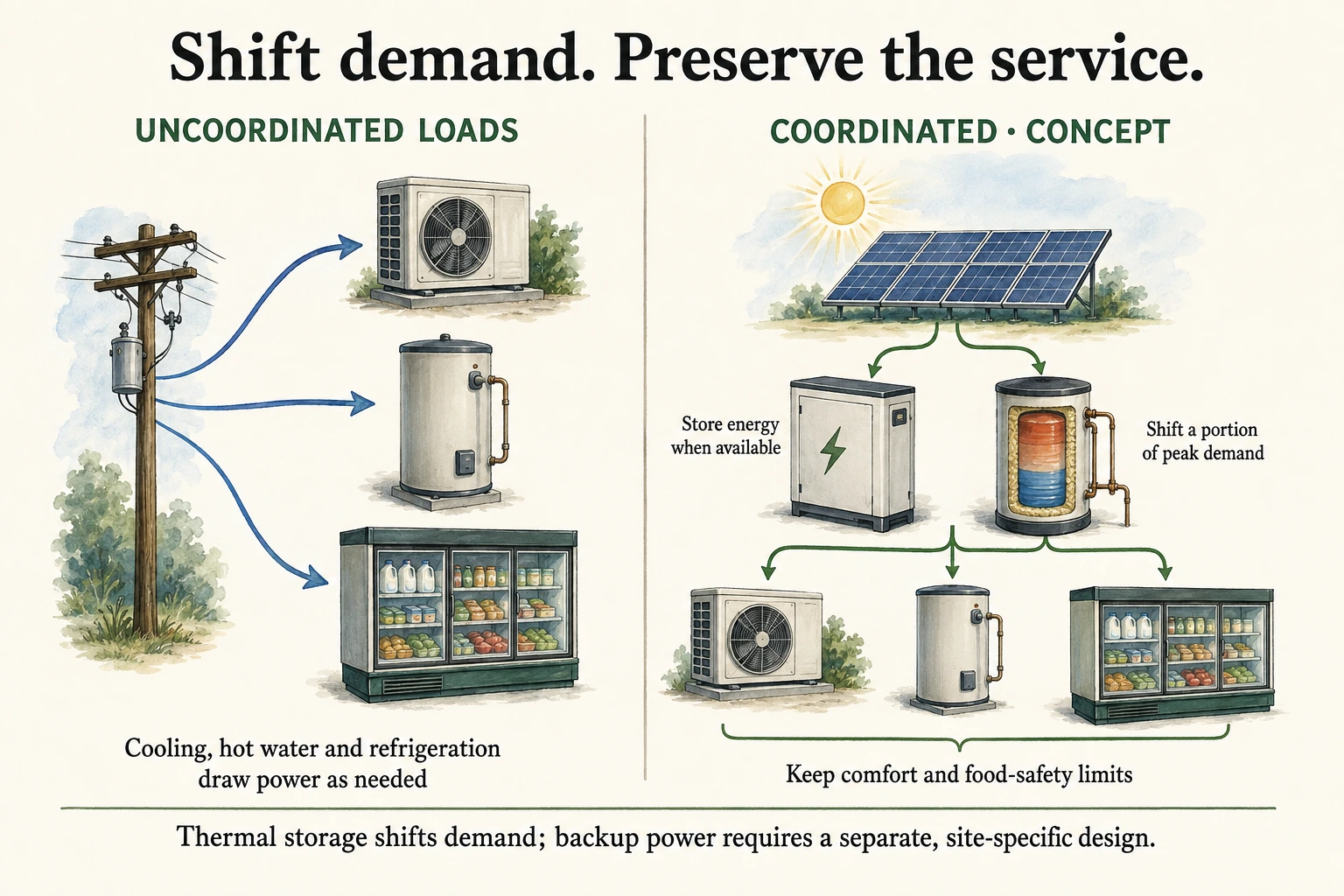
The model’s main lever is method. If an installation method removed 60% of the field hours, for instance with equipment that arrives with its refrigerant circuit sealed at the factory or that plugs into an existing circuit, the same 10,000 homes would need about 159 workers. HVAC technicians would fall to 62, about 32% of the assumed available pool; electricians to 48, about 10%.
Electrician hours fall less than the rest because the panel and service work stays: about 3,500 homes a year at roughly 18 hours each, 63,000 hours, the equivalent of 35 full-time electricians before a single unit is mounted. That is where field labor and the electrical wall meet. Each home that can manage its load instead of upgrading its service takes about two days of an electrician’s time off the list.
The case against a shortage
The strongest counter-argument is that labor markets adjust. Contractors hire when work is steady; helpers become technicians; mainland crews take island jobs when the pay is there, and Hawaiʻi’s electricians already earn more on average than California’s. The solar trade has grown to 120,570 systems on Hawaiian Electric’s grids, and almost all of its new installations already include batteries. The 15% availability figure is an assumption, not a measurement, and a different one changes the answer.
Those points are fair, and they argue for treating the workforce as something to build rather than a fixed ceiling. But the record cuts the other way too. The apprentice pool was flat in the last reported year. The population is falling, with net migration running against the islands. And higher wages to draw mainland crews would be paid, in the end, by Hawaiʻi households, in installation prices.
What a compact would buy
A workforce compact would tie the halves together: state and utility programs that commit to a multiyear volume of work so contractors can hire against it, apprenticeship slots sized to that volume, and incentives that pay for installed, working systems rather than equipment, so that methods using fewer field hours are rewarded rather than penalized.
Fifty thousand is a count of systems. Before it is a number of homes, it is a number of working hours, and Hawaiʻi has only so many of them.
Read next
Commentary · Hawaiʻi · October 1, 2026
CommentaryHawaiʻi cannot import its way to 2045
The state ships in the fuel, the equipment and, increasingly, the skilled labor its energy plan depends on. The part it can most realistically keep at home is the work of assembli…

Grid · Hawaiʻi · October 2, 2026
The Evening PeakOʻahu’s 7 p.m. problem: the sun sets and oil carries the evening
Rooftop solar fills the middle of the day. When it fades, Oʻahu still turns to oil. What the utility is buying for the 2030s, what customer batteries can carry now, and what they…
Markets · Hawaiʻi · California · September 24, 2026
AnalysisHawaiʻi’s electricity hit 52.72 cents in June, nearly triple the U.S. average
Federal data put the state’s residential price up almost 29% in a year, and oil explains the swing. California’s high prices have a different cause. The hour of use is the one par…