
The docket · PMF-HI-26-008 · Hawaiʻi · DRAFT
Model proposal · not current law
Installer Workforce Compact
A trades plan to match Gov. Green’s goal of 50,000 distributed renewable installations by 2030: publish the field-hour arithmetic, expand electrical and HVAC apprenticeship capacity and completion, review licensing scope without lowering line-voltage standards, reward equipment that cuts field hours, and require island-based maintenance in public programs.
October 2026 · Model proposal tied to Executive Order 25-01
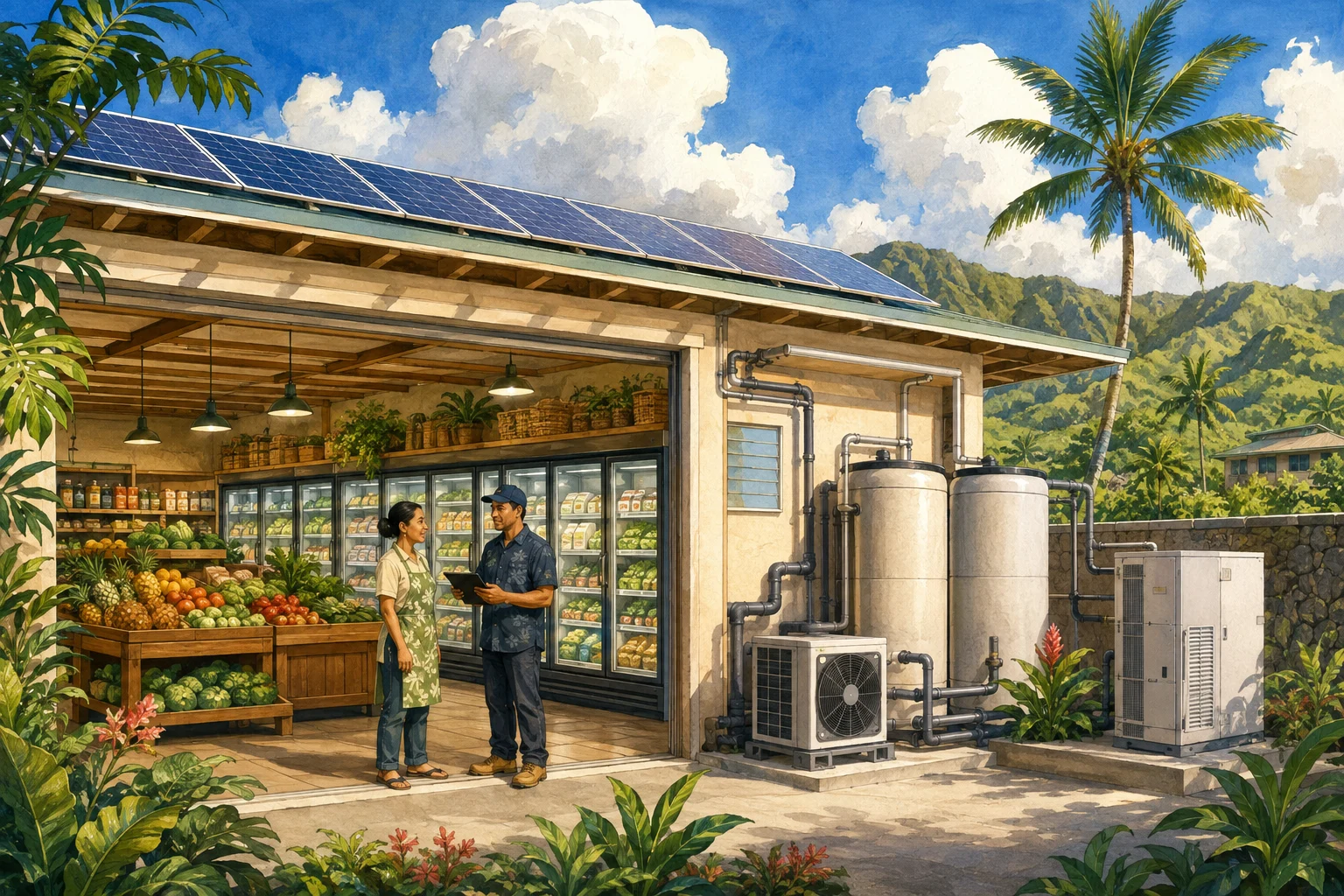
Executive Order 25-01, signed by Gov. Josh Green on January 29, 2025, set a statewide goal of 50,000 distributed renewable energy installations, such as rooftop solar and battery systems, by 2030. That is roughly 8,000 to 10,000 installations a year, depending on when the count starts. The goal comes from the executive order, not from Act 266, which directs the Public Utilities Commission to set its own 2030 goal without specifying a number.
The people who would do the work are few. The Bureau of Labor Statistics counted 3,070 electricians in Hawaiʻi in May 2025, with a mean annual wage of $92,870, and 1,300 heating, air-conditioning and refrigeration mechanics, with a mean of $67,070 — below California’s $75,370 for the same trade. Hawaiʻi had 5,406 registered apprentices across all trades in December 2024. In the year to September 30, 2024, 1,621 apprentices registered or were reinstated, 496 completed and 1,119 cancelled.
The labor pool is also shrinking. Hawaiʻi’s population fell by 2,132 to 1,432,820 in the year to July 1, 2025, with net domestic out-migration of 8,876 people, about 24 a day. Nationally, BLS projects about 72,700 electrician openings and 40,600 HVAC openings a year through 2035, so mainland employers compete for the same workers.
The Federation’s model frames the arithmetic. At 10,000 heat-pump installations a year — a stand-in for field labor, since the executive order counts solar and battery systems — conventional methods would need about 346 full-time field workers, including HVAC technicians equal to about 80 percent of an assumed 15 percent of the state’s HVAC workforce available for this work. Equipment and methods that cut field hours by 60 percent would reduce that to about 159 workers. Training takes years; labor-saving design and task-sharing are the levers available before 2030.
The record
The record
The State Energy Office’s January 29, 2025, release describes EO 25-01 as “setting a statewide goal of 50,000 distributed renewable energy installations (such as rooftop solar and battery systems) by 2030.” PMF has not reviewed the signed order itself. Act 266 (2025) separately requires the PUC to set a 2030 goal for customer-sited resources without a statutory number.
What the numbers say
BLS OEWS, May 2025: Hawaiʻi electricians 3,070 (mean $92,870); HVACR mechanics 1,300 (mean $67,070). California: 73,310 electricians and 35,130 HVACR mechanics. BLS projects 9 percent growth for electricians and 11 percent for HVACR over 2025–35, with about 72,700 and 40,600 openings a year nationally.
Apprenticeship
DLIR reported 5,406 registered apprentices in Hawaiʻi as of December 9, 2024, across all trades. From October 1, 2023, to September 30, 2024: 1,621 newly registered or reinstated, 1,119 cancelled, 496 completed. In December 2024 the State Apprenticeship Council recommended approval of revised Hawaiʻi Electricians Training Fund wireperson standards admitting applicants with 240-hour certificate programs and SkillBridge veterans for direct entry.
Population
DBEDT estimates Hawaiʻi’s population at 1,432,820 on July 1, 2025, down 2,132 (0.15 percent) from 2024 and down 22,447 since April 2020. Net domestic migration was −8,876 in 2024–25.
What the model shows
The Federation’s install model prices a conventional single-family heat-pump installation on Oʻahu at about $9,770, including about $5,240 of labor over 56 field hours. Its workforce model estimates that 10,000 such installations a year need about 346 full-time field workers (156 HVAC technicians, 122 helpers, 68 electricians); cutting field hours by 60 percent reduces that to about 159. In California, SPUR’s analysis of TECH Clean California data puts installation at about 70 percent of a heat pump’s cost.
What we propose
- 01Publish, alongside annual EO 25-01 progress reports, the field labor the installations required: trade hours by occupation and island, licensed workers active, and apprentices enrolled by trade.
- 02Fund additional related-instruction capacity for electrical and HVACR apprenticeships at community colleges and joint training funds, with a public target of raising the completion-to-cancellation ratio from the 2023–24 level of about 0.44.
- 03Expand direct-entry credit for verified prior training, building on the Hawaiʻi Electricians Training Fund’s December 2024 revisions that admit graduates of 240-hour certificate programs and Department of Defense SkillBridge participants.
- 04Commission a Department of Commerce and Consumer Affairs review of whether limited-scope endorsements for tasks such as low-voltage controls, plug-in equipment and battery commissioning can safely move work from journeyworkers, without changing licensing requirements for line-voltage wiring.
- 05In State-funded and ratepayer-funded installation programs, score bids partly on documented field hours per installation, so that any design that reduces on-site labor — factory assembly, plug-in connection, avoided service upgrades — competes on measured results.
- 06Require public programs to fund a maintenance plan with island-based technicians, stated response times and parts stocking for every installation they support.
- 07Coordinate with DLIR to publish annual Hawaiʻi wage, retention and out-of-state migration data for electricians and HVACR technicians.
Who pays, who benefits
- Apprenticeship expansion is paid by employers (wages), joint training funds and the State (instruction). PMF has not found a published per-apprentice instruction cost for Hawaiʻi; the plan should produce one.
- Workers benefit directly: Hawaiʻi’s mean electrician wage was $92,870 in May 2025. Retaining trained workers against mainland competition may require wage growth that raises installation costs.
- Households pay for labor in every installation; in the model it is more than half of a conventional single-family heat-pump job. Field-hour reductions lower that share, though some labor-saving equipment costs more to buy.
- Maintenance requirements add a modest recurring cost to public programs and keep service work, and the jobs that come with it, on each island.
Test the numbers
Objections
“Limited-scope endorsements are a way to cut licensed electricians out of work they are trained to do safely.”
The proposal leaves line-voltage licensing untouched and asks only for a review of narrowly defined tasks. Unions and the licensing boards should be central to that review, and its findings should be public.
“Scoring bids on field hours favors particular products.”
The measure is documented hours on site, not a technology. Any design or method that reduces them — including better crew organization — scores the same way.
“Apprenticeships take four or five years; none of this produces workers by 2030.”
Largely true, which is why the near-term levers are labor-saving equipment, direct-entry credit and task-sharing. The pipeline matters beyond 2030, because tens of thousands of new systems will need maintenance for decades.
What to watch
- Progress reporting on EO 25-01’s 50,000-installation goal, and the PUC’s separate 2030 goal under Act 266 §269-A(a).
- DLIR State Apprenticeship Council meetings and annual registration, completion and cancellation figures.
- BLS OEWS May 2026 state estimates, expected in spring 2027.
- 2027 Legislature (convenes January 2027): workforce, licensing and apprenticeship funding measures.
- Act 24’s $40 million cap on the state renewable energy tax credit from 2027, which may slow installation demand and change hiring plans.
Sources
- Hawaiʻi State Energy Office, release on Executive Order 25-01, January 29, 2025
- Act 266, Session Laws of Hawaiʻi 2025 (SB 589 CD1), approved July 2, 2025
- BLS Occupational Employment and Wage Statistics, May 2025, state estimates (47-2111 electricians; 49-9021 HVACR mechanics)
- BLS Occupational Outlook Handbook, Electricians (2025–35 projections)
- BLS Occupational Outlook Handbook, Heating, Air Conditioning, and Refrigeration Mechanics and Installers
- Hawaiʻi DLIR Workforce Development Division, State Apprenticeship Council draft minutes, December 10, 2024
- DBEDT / Hawaiʻi State Data Center, 2025 state population estimates, January 27, 2026
- SPUR, “Three measures drive down the high cost of heat pump installation” (TECH Clean California data), August 6, 2026
- U.S. EPA, Section 608 Technician Certification
- Airform open grid and building models (assumptions and sources); Airform makes heat-pump and battery equipment
Reporting

Commentary · Hawaiʻi · October 1, 2026
CommentaryHawaiʻi cannot import its way to 2045
The state ships in the fuel, the equipment and, increasingly, the skilled labor its energy plan depends on. The part it can most realistically keep at home is the work of assembli…
Labor · Hawaiʻi · September 29, 2026
AnalysisHawaiʻi’s energy goals run through 3,070 electricians and 1,300 HVAC techs
The governor’s goal is 50,000 distributed energy installations by 2030. The licensed trades that would do the work are small, well paid and barely growing. The Federation’s model…