
THE DOCKET · PMF-HI-26-001
DRAFTPortable Solar Access and Safety Framework
September 2026 · Model proposal for public discussion
A limited pathway for portable solar in apartments and condominiums: listed equipment, a narrow capacity ceiling, no-fee registration, clear customer disclosures, and reasonable building-safety review. It expands access without declaring plug-in solar universally permitted.
Policy rationale
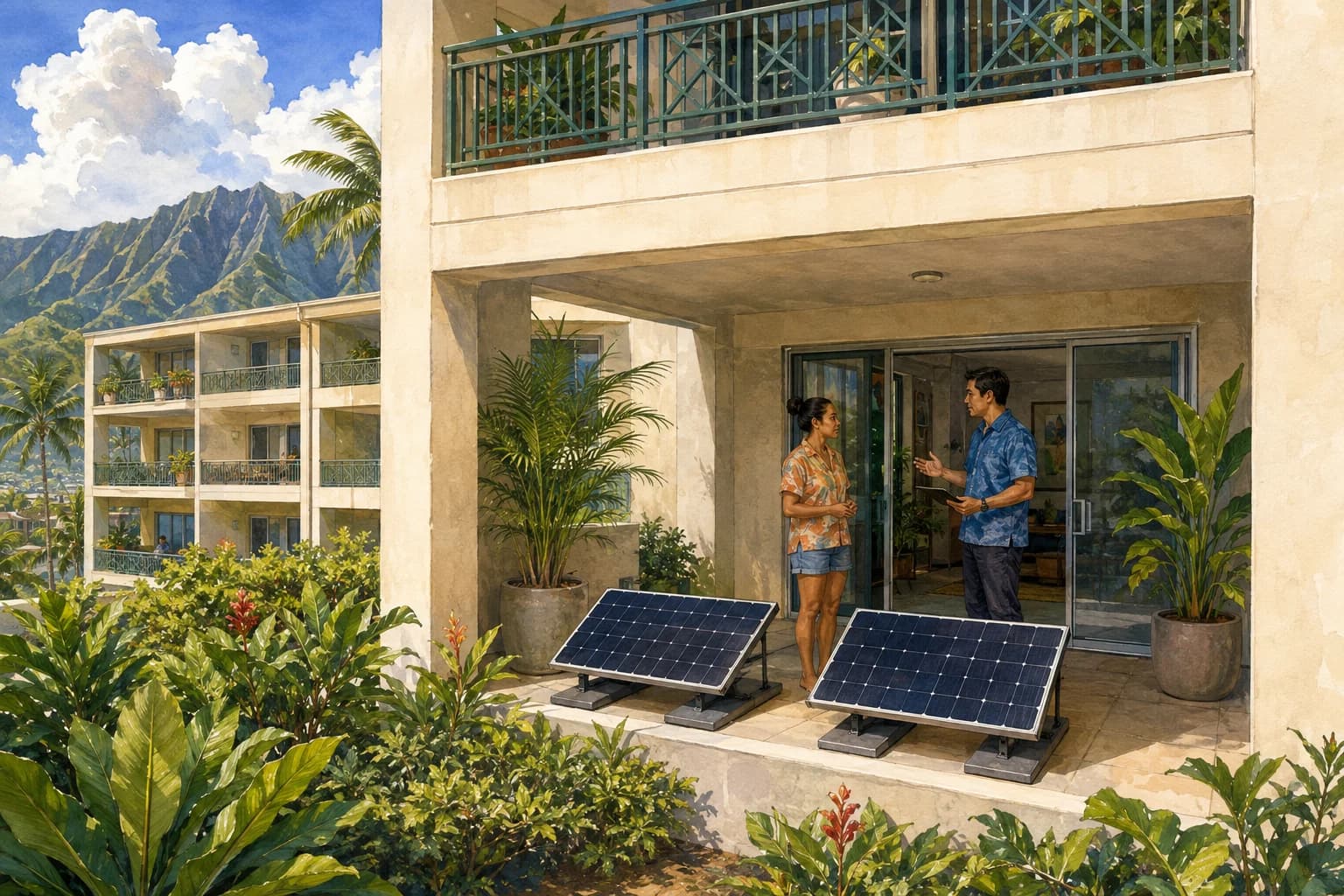
Hawaiʻi has no blanket authorization for plug-in or balcony solar. Senate Bill 2902 offered a useful 2026 starting point—a portable device class up to 1.2 kilowatts, a 120-volt connection concept, anti-islanding, certification, and no-fee registration—within condominium units, including rented condominium units. The official 2026 measure history shows that it did not become an operating statewide framework. The first requirement is accuracy: residents, associations, and installers need to know what is proposed and what remains subject to code and utility rules.
PMF proposes a time-limited condominium and multifamily pilot for a narrow, nationally listed device class. Qualifying equipment would meet the applicable certification and anti-islanding or non-export requirements as a tested system or through code-compliant installation, and follow county electrical, fire, structural, wind, egress, and mounting rules. The pathway should replace individualized utility study and fee requirements only where the Commission has determined that the product class can safely use a simplified process.
The policy should protect access without stripping property safety rules. Associations and landlords should not impose arbitrary bans on qualifying devices, but they may apply published, reasonable conditions for common elements, exterior attachment, maintenance, insurance, and removal. Consumers should receive plain-language output, bill-savings, export, outage-power, warranty, and maintenance disclosures before purchase.
Evidence and implementation
Implementation dossier: portable solar access and safety
A narrowly governed access pilot can help residents use small solar equipment without treating electrical, building, fire, or utility safety requirements as optional.
Evidence reviewed September 7, 2026
Define two pathways before offering access
Evidence & PMF analysisSource context & PMF recommendation
SB 2902 HD1 is used here as a legislative proposal, not as installation permission. Its proposed condominium-device class was limited to 1.2 kW and described a standard 120-volt connection, anti-islanding, certification, and registration. PMF proposes a broader housing-access pilot for responsible public bodies to consider; this text does not authorize a resident to connect equipment today.
Sources: SB 2902 HD1 proposed bill text (Hawaiʻi Legislature)
PMF recommendation
PMF recommendation: publish two separate pathways. A self-contained DC solar-to-appliance system may charge or serve a compatible DC load behind its listed controls. An AC-connected system that can energize premises wiring requires a distinct, code-compliant permission path. An MPPT controller improves DC power conversion; it is not anti-islanding, a product listing, an interconnection agreement, or permission to backfeed an outlet.
| Pathway | Proposed PMF scope | Suggested decision gate |
|---|---|---|
| Self-contained DC | Listed PV, wiring, charge control, and a compatible isolated load. | Product instructions, mounting review, and county code compliance. |
| AC-connected non-export | Premises AC use only after an accepted non-export profile is verified. | Whole-system listing, anti-islanding, utility/PUC process where required, and AHJ approval. |
| Export-capable DER | Generation eligible to interact with the grid under an adopted tariff. | Normal interconnection, tariff, metering, and protection requirements. |
Two solar pathways need different compliance checks
Classify the complete system by what it connects to and whether it can energize premises AC wiring. An MPPT controller by itself does not establish interconnection compliance.
Pathway A
DC solar to a dedicated appliance
- PV module
- Compatible DC charge control
- Battery / appliance load
Evaluate the complete appliance, battery, DC protection and mounting arrangement. This pathway describes a system that does not energize premises AC wiring.
Pathway B
Solar connected to premises AC
- PV module
- Listed inverter / system
- Premises AC connection
Equipment certification, anti-islanding, circuit protection, connection method and the applicable utility process all matter. A product label does not waive local requirements.
| Question | Dedicated DC appliance | Premises AC system |
|---|---|---|
| What receives power? | A compatible dedicated DC appliance or battery system | Premises electrical wiring through an inverter |
| What does MPPT do? | Controls solar power conversion / charging | May optimize PV input; does not establish grid compliance |
| What needs review? | Whole-system compatibility, protection, siting and secure mounting | Whole-system listing, anti-islanding, circuit and interconnection requirements |
| What law is established here? | No blanket Hawaiʻi exemption is asserted | Utah is a bounded precedent; Hawaiʻi SB 2902 HD1 is cited as a proposal |
These are system categories, not product approvals. UL 3700 is a testing framework; local law, product listing and installation approval remain separate questions. Renters and condominium residents need a clear, objective safety review pathway.
Source context · reviewed September 7, 2026
- HB 340 enrolled legislation — Utah Legislature. Bounded Utah statutory precedent, not Hawaiʻi permission.
- Plug-in solar testing and certification framework — UL Solutions. Certification framework does not certify every product or waive local codes.
- UL 3700 Outline of Investigation — UL Standards & Engagement. Equipment/system scope; distinguish from site approval.
- SB 2902 HD1 proposed bill text — Hawaiʻi Legislature. Proposal text; not cited as enacted law.
Qualify equipment and buildings, not marketing claims
Evidence & PMF analysisSource context & PMF recommendation
UL has published a plug-in-solar testing and certification framework, but a framework does not certify a particular product or waive local code. PMF recommends that a pilot accept only a complete, traceable system: module, inverter or charge-control equipment, cables, disconnects, mounting, instructions, and any storage component must match the listing and installation design.
Sources: Plug-in solar testing and certification framework (UL Solutions)UL 3700 Outline of Investigation (UL Standards & Engagement)
PMF recommendation
PMF recommendation: counties and the authority having jurisdiction should publish one common checklist for electrical condition, wind and corrosion exposure, fire access, egress, structural attachment, balcony loading, outlet or dedicated-circuit suitability, and removal. A device with storage should receive the appropriate storage and fire review rather than being treated as an ordinary plug-in panel. A simplified process is earned by verified compliance, not assumed from size alone.
Protect renters and owners while assigning real responsibilities
PMF recommendationA resident in a qualifying rental, condominium, townhome, or multifamily unit should be able to request a review without a categorical ban. The owner or association may apply published conditions tied to common property, weather exposure, insurance, repairs, access, or safety. It should respond by a stated deadline, identify the objective reason for any denial, and offer an appeal route. This protects access without forcing an owner to accept an unsafe exterior installation.
The installer or provider should bear responsibility for workmanship, product registration, warranty administration, removal instructions, and damage caused by its work. Before purchase, the resident should receive a plain-language statement of expected output, bill effect, export treatment, outage capability, maintenance, data collection, and the difference between equipment ownership and a service subscription. No provider should sell resilience or utility-bill savings as guaranteed.
Use a small public pilot and scale only on evidence
PMF recommendationPMF recommends a time-limited cohort across several building types and counties, financed through a capped demonstration appropriation, philanthropy, or participating-provider contribution—not assumed export compensation. The pilot administrator would procure listed equipment and qualified installation support through an open, technology-neutral request. Participants should not be charged a hidden enrollment fee or assigned liability for a manufacturer or program administrator failure.
Only the minimum data needed for safety and evaluation should be collected: approved system class, installation date, incident and complaint record, anonymized output where consented to, and customer-reported bill and housing-access experience. Expansion should require an independent report on installation time and cost, code findings, wind or fire incidents, removals, tenant disputes, recalls, and any measurable grid impact. A failed safety or consumer-protection threshold pauses expansion until corrected.