
RESEARCH · POLICY FRAMEWORK · September 2026 · Policy research · 8 min
Portable solar for apartments and condominiums: a safety-first path.
Rooftop solar is unavailable to many renters and condominium residents. Hawaiʻi can create a limited portable-solar pathway that broadens access without treating electrical, fire, structural, or consumer-protection requirements as optional.
1.2 kW
maximum output in the 2026 proposal
120 V
standard outlet connection described in the proposal
$0
recommended customer registration fee
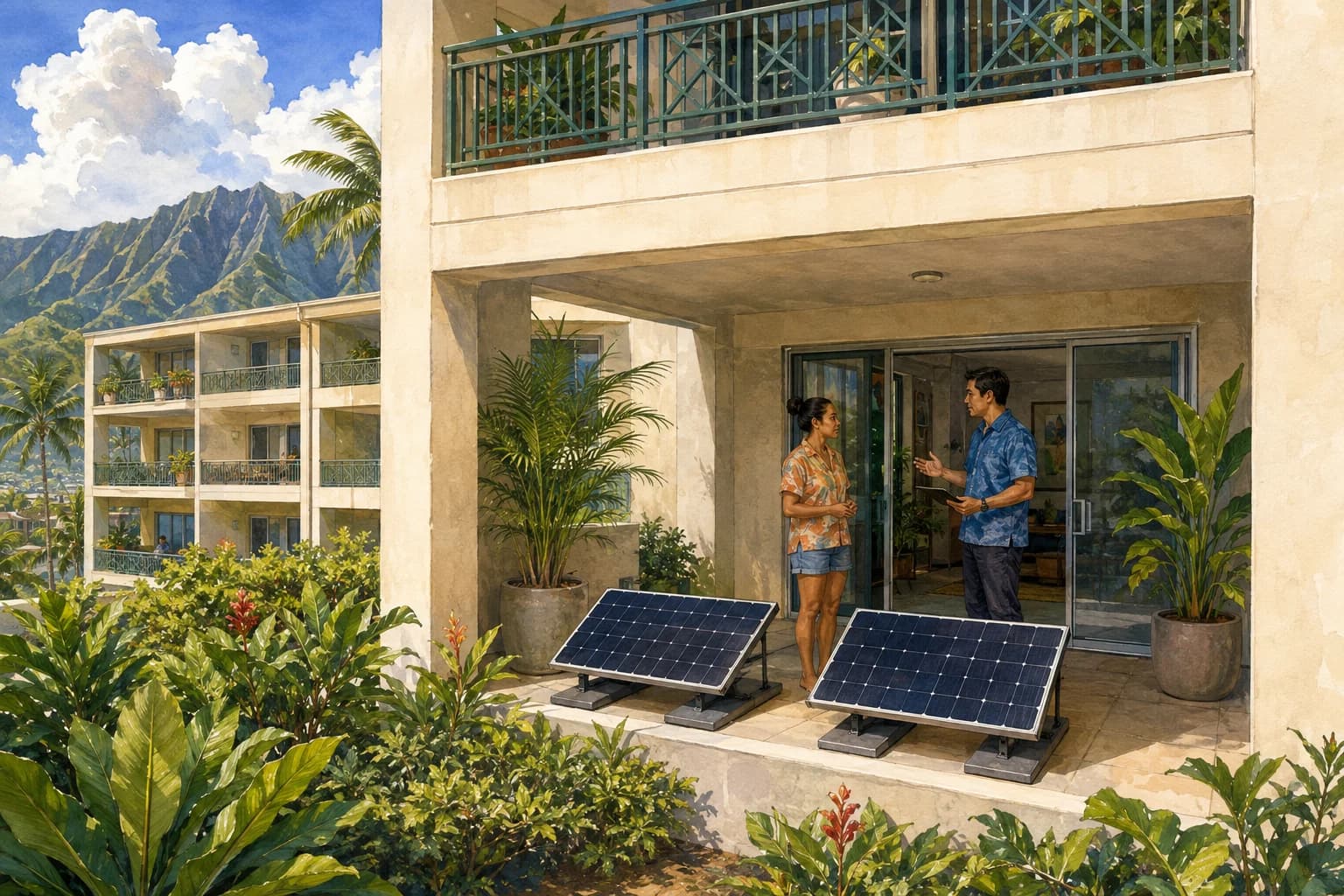
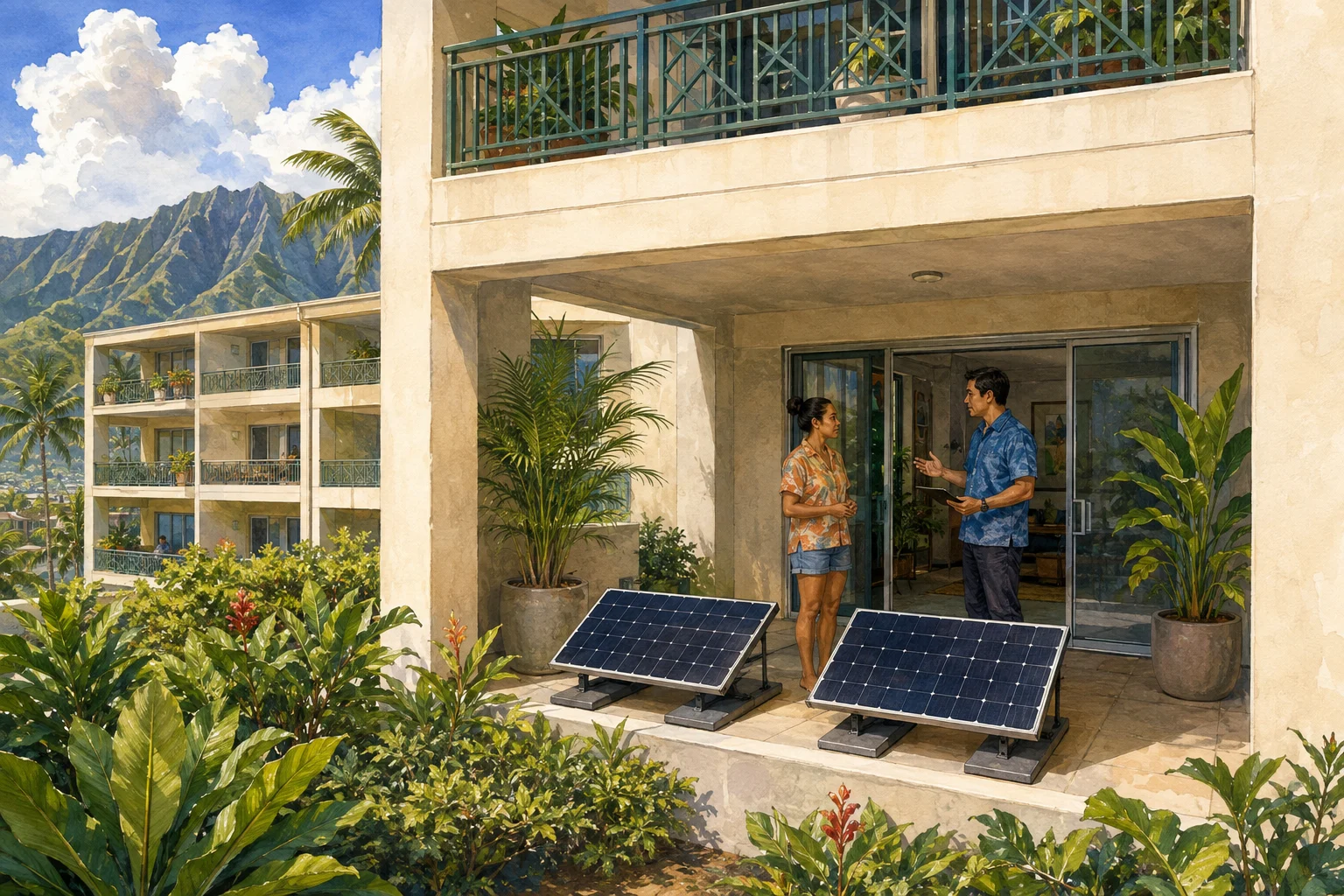
AI-generated concept · Proposed portable-solar access; not an approved installation or enacted program.
Legal baseline
The 2026 bill was a useful proposal, not current law.
Hawaiʻi Senate Bill 2902, in its 2026 House draft, proposed a narrow class of portable solar generation devices: moveable photovoltaic equipment of no more than 1.2 kilowatts intended to connect through a standard 120-volt outlet and offset customer consumption. The House draft limited that proposal to condominium units, including rented condominium units; it did not create a general authorization for every apartment or balcony configuration statewide.
The proposal required an anti-islanding feature, directed the Public Utilities Commission to identify a recognized certification standard, and contemplated no-fee online registration. The official 2026 measure history shows it did not become law, and its House draft carried an effective date of July 1, 3000. It should therefore be treated as a policy reference, not an enacted statewide framework.
A future law should begin with a limited, well-defined device class and expand only after evidence supports it. Any broader apartment or rental pathway would need separately defined authority and safeguards. The objective is access for residents who cannot use a roof—not a shortcut around legitimate electrical, fire, structural, or utility safety obligations.
2026
year of the SB 2902 proposal
1
narrow device class before broader deployment
AI-generated concept · Proposed portable-solar access; not an approved installation or enacted program.
Standards
Safety must be designed into the listed system.
The policy path should require nationally recognized safety certification, anti-islanding or verified non-export behavior as applicable, durable mounting, current county electrical and fire-code compliance, and a product-level instruction set written for ordinary residents. Electrical, power-conversion, and charge-control components should be part of a tested, listed system or installed under applicable code by qualified professionals; the policy should not prescribe a particular control architecture.
A simple registration pathway should collect only the information needed for safety oversight and program evaluation. Qualifying equipment should not face an individualized utility study or fee solely because it is portable, but the State and counties must retain the ability to act on unsafe installations, product recalls, or repeated incidents.
Consumer disclosures should state realistic generation and bill-savings ranges, whether export compensation is available, whether the device provides outage power, any required permissions, warranty terms, and maintenance obligations. A small PV system can reduce purchased energy; it should never be advertised as backup power unless the installed system is designed and permitted to provide it.
0
assumed export compensation
0
unverified outage-power claims
AI-generated concept · Proposed portable-solar access; not an approved installation or enacted program.
Housing access
Condominium and landlord rules should be reasonable, not arbitrary.
Portable solar is an access policy because many households do not control a roof, own their dwelling, or have the capital for a conventional solar installation. The law should protect a resident’s ability to propose qualifying equipment while preserving reasonable rules for building attachment, wind exposure, common areas, egress, appearance, insurance, and maintenance.
A workable rule would prohibit blanket bans on qualifying devices but allow a condominium association or landlord to apply published, safety-based conditions. It should include prompt review timelines, an appeal path, and a clear distinction between equipment placed inside a unit and equipment attached to a building exterior.
The policy should remain vendor-neutral. Standards should describe performance, safety, interoperability, and consumer outcomes rather than prescribe a proprietary enclosure, controller, or business model. That protects residents, gives local installers choices, and makes the rule more durable.
1
published safety review process per building
0
blanket bans on qualifying equipment
AI-generated concept · Proposed portable-solar access; not an approved installation or enacted program.
Implementation
Run a measured pilot before scaling the rule.
PMF recommends a time-limited pilot across more than one county and housing type. Enrollment should include a registration record, consent to aggregate anonymous performance data, product information, installation location, and a consumer acknowledgement of the device’s limits.
The public scorecard should track device count, customer-reported bill effects, equipment failures, safety incidents, complaints, condominium or landlord disputes, utility impacts, and demographic access. It should publish both successful and unsuccessful outcomes before the State changes the device ceiling or extends the program beyond the pilot.
A pilot does not eliminate the need for code review. It creates a structured way for the Commission, counties, utilities, housing stakeholders, consumer advocates, firefighters, and installers to settle the open questions with evidence rather than assumption.
3
minimum outcome categories: customer, safety, grid
1
public report before expansion
01 / 04
Legal baseline
AI-generated concept · Proposed portable-solar access; not an approved installation or enacted program.
Evidence and implementation
Implementation update: two solar pathways
September 7, 2026 update. Equipment that supplies an appliance through DC and equipment connected to premises AC wiring need distinct compliance pathways.
Evidence reviewed September 7, 2026
Define the electrical connection precisely
Evidence & PMF analysisTechnical guidance · source context
UL’s plug-in solar framework and UL 3700 address equipment and system evaluation. They do not certify every product, authorize every installation, or waive local electrical and building requirements.
Sources: Plug-in solar testing and certification framework (UL Solutions)UL 3700 Outline of Investigation (UL Standards & Engagement)
PMF recommendation
PMF recommends separate descriptions for solar supplying a compatible appliance or battery through a DC connection and solar equipment capable of energizing premises AC wiring. MPPT manages solar power extraction; its presence alone does not establish interconnection certification. Each pathway needs whole-system compatibility, safe installation, and clear instructions matched to its actual electrical behavior.
Two solar pathways need different compliance checks
Classify the complete system by what it connects to and whether it can energize premises AC wiring. An MPPT controller by itself does not establish interconnection compliance.
Pathway A
DC solar to a dedicated appliance
- PV module
- Compatible DC charge control
- Battery / appliance load
Evaluate the complete appliance, battery, DC protection and mounting arrangement. This pathway describes a system that does not energize premises AC wiring.
Pathway B
Solar connected to premises AC
- PV module
- Listed inverter / system
- Premises AC connection
Equipment certification, anti-islanding, circuit protection, connection method and the applicable utility process all matter. A product label does not waive local requirements.
| Question | Dedicated DC appliance | Premises AC system |
|---|---|---|
| What receives power? | A compatible dedicated DC appliance or battery system | Premises electrical wiring through an inverter |
| What does MPPT do? | Controls solar power conversion / charging | May optimize PV input; does not establish grid compliance |
| What needs review? | Whole-system compatibility, protection, siting and secure mounting | Whole-system listing, anti-islanding, circuit and interconnection requirements |
| What law is established here? | No blanket Hawaiʻi exemption is asserted | Utah is a bounded precedent; Hawaiʻi SB 2902 HD1 is cited as a proposal |
These are system categories, not product approvals. UL 3700 is a testing framework; local law, product listing and installation approval remain separate questions. Renters and condominium residents need a clear, objective safety review pathway.
Source context · reviewed September 7, 2026
- HB 340 enrolled legislation — Utah Legislature. Bounded Utah statutory precedent, not Hawaiʻi permission.
- Plug-in solar testing and certification framework — UL Solutions. Certification framework does not certify every product or waive local codes.
- UL 3700 Outline of Investigation — UL Standards & Engagement. Equipment/system scope; distinguish from site approval.
- SB 2902 HD1 proposed bill text — Hawaiʻi Legislature. Proposal text; not cited as enacted law.
Use precedent without importing permission
Evidence & PMF analysisTechnical guidance · source context
Utah’s enrolled HB 340 provides a bounded legislative precedent for portable solar. Hawaiʻi’s SB 2902 HD1 is proposal text, not cited here as enacted law. Neither source grants a resident permission to install an unspecified device in Hawaiʻi.
Sources: HB 340 enrolled legislation (Utah Legislature)SB 2902 HD1 proposed bill text (Hawaiʻi Legislature)
PMF recommendation
PMF recommends common terminology across legislation, utility rules, and county guidance. The review should resolve equipment eligibility, attachment, building exposure, registration, and enforcement. Residents should receive one clear compliance checklist rather than be expected to reconcile inconsistent institutional descriptions.
Make resident access administratively workable
PMF recommendationPMF recommends objective safety grounds for a landlord or association to require changes, a prompt written decision, and a practical appeal. A resident’s limited roof rights should not automatically end the inquiry. Building attachment, wind loading, egress, common areas, and responsibility for removal still require an identified decision-maker.
A monitored cohort should record final installation costs, approval times, faults, recalls, and disputes. Offer assistance that includes compliant mounting and instructions, not simply equipment purchase. Expand eligibility only after publishing what the initial deployments show about customer access and safe operation.