
RESEARCH · DECISION FRAMEWORK · September 2026 · Policy research · 11 min
What Hawaiʻi should ask before building LNG infrastructure.
Liquefied natural gas may compare differently with residual fuel oil in a particular operating case. It is not a renewable resource, and any long-lived import infrastructure should clear a transparent, independently reviewed full-cost test against local clean-resource and flexibility portfolios.
38–44%
HSEO’s estimated lifecycle reduction versus LSFO in one efficient-plant case
2045
statutory renewable-electricity deadline
500 MW
additional Oʻahu firm capacity under review by Hawaiian Electric


AI-generated concept · Hypothetical LNG infrastructure, not an existing Hawaiʻi terminal or selected project.
What is known
LNG may be a lower-carbon fossil fuel than fuel oil; it is not a clean-energy plan.
The Hawaiʻi State Energy Office’s Alternative Fuels, Repowering, and Energy Transition Study finds that imported LNG used in more efficient power plants could reduce lifecycle carbon intensity by roughly 38% to 44% compared with low-sulfur fuel oil. The study also describes uncertainty in fuel availability, costs, and lifecycle emissions, and says further engineering and regulatory work would be required.
That comparison should be stated fairly. A reduction relative to residual fuel oil is not the same as renewable generation or zero emissions. Hawaiʻi’s renewable-energy definition lists wind, solar, geothermal, biogas, biomass, renewable hydrogen, and other named sources; LNG is not on that list and cannot itself satisfy the renewable portfolio standard.
The policy question is therefore narrower than a slogan: can a limited, temporary fossil-fuel option meet a defined reliability need at lower total customer risk than a portfolio of local renewable generation, storage, flexible demand, efficiency, and grid upgrades? The answer must come from a published comparison, not from a fuel-price assertion alone.
1
comparison baseline: a defined system need
0%
LNG contribution to the statutory RPS by itself
AI-generated concept · Hypothetical LNG infrastructure, not an existing Hawaiʻi terminal or selected project.
Ratepayer risk
A sole-source fuel commitment is not a least-cost finding.
In July 2026, Hawaiian Electric described a Commission-supervised, competitive process for renewable energy, storage, and firm capacity. It also stated that any expanded Oʻahu firm-generation procurement should be evaluated transparently without predetermining the resource size or fuel requirement.
That is the right procedural baseline. A proposal for imported LNG should disclose the terminal, ship, generation conversion or construction, grid upgrades, financing, insurance, fuel supply, price-index, hedging, take-or-pay, decommissioning, and stranded-asset assumptions that will be borne by ratepayers.
A full-cost review should use high, central, and low fuel-price and availability cases; a credible renewable-fuel transition case; and a stated retirement or conversion obligation compatible with Hawaiʻi’s 2045 standard. If a proposal cannot survive those cases without shifting risk to customers, it should not receive cost recovery.
3
minimum fuel-price cases in a public review
2045
required compatibility checkpoint
AI-generated concept · Hypothetical LNG infrastructure, not an existing Hawaiʻi terminal or selected project.
Lifecycle accounting
The climate comparison must include the entire LNG supply chain.
The International Energy Agency finds that LNG supply-chain emissions vary widely and that LNG generally has higher emissions than gas delivered by shorter pipelines because liquefaction and long-distance transport require substantial energy. Its assessment covers upstream production, processing, transmission, liquefaction, shipping, regasification, methane, flaring, carbon dioxide, and energy use.
A Hawaiʻi decision should therefore report lifecycle greenhouse gases using transparent 20-year and 100-year methane assumptions, source-specific data where available, and ranges rather than a single optimistic number. It should also report what is excluded, including combustion, distribution, or avoided-emissions assumptions, so the public can see where the comparison begins and ends.
A lifecycle test is not a substitute for a cost and reliability test. It is one required lens. The State should demand that every resource option, including storage, demand response, renewable fuels, and LNG, be evaluated against the same system need and the same disclosure rules.
5×+
range in upstream-to-delivery emissions noted by IEA
2
methane time horizons for public reporting

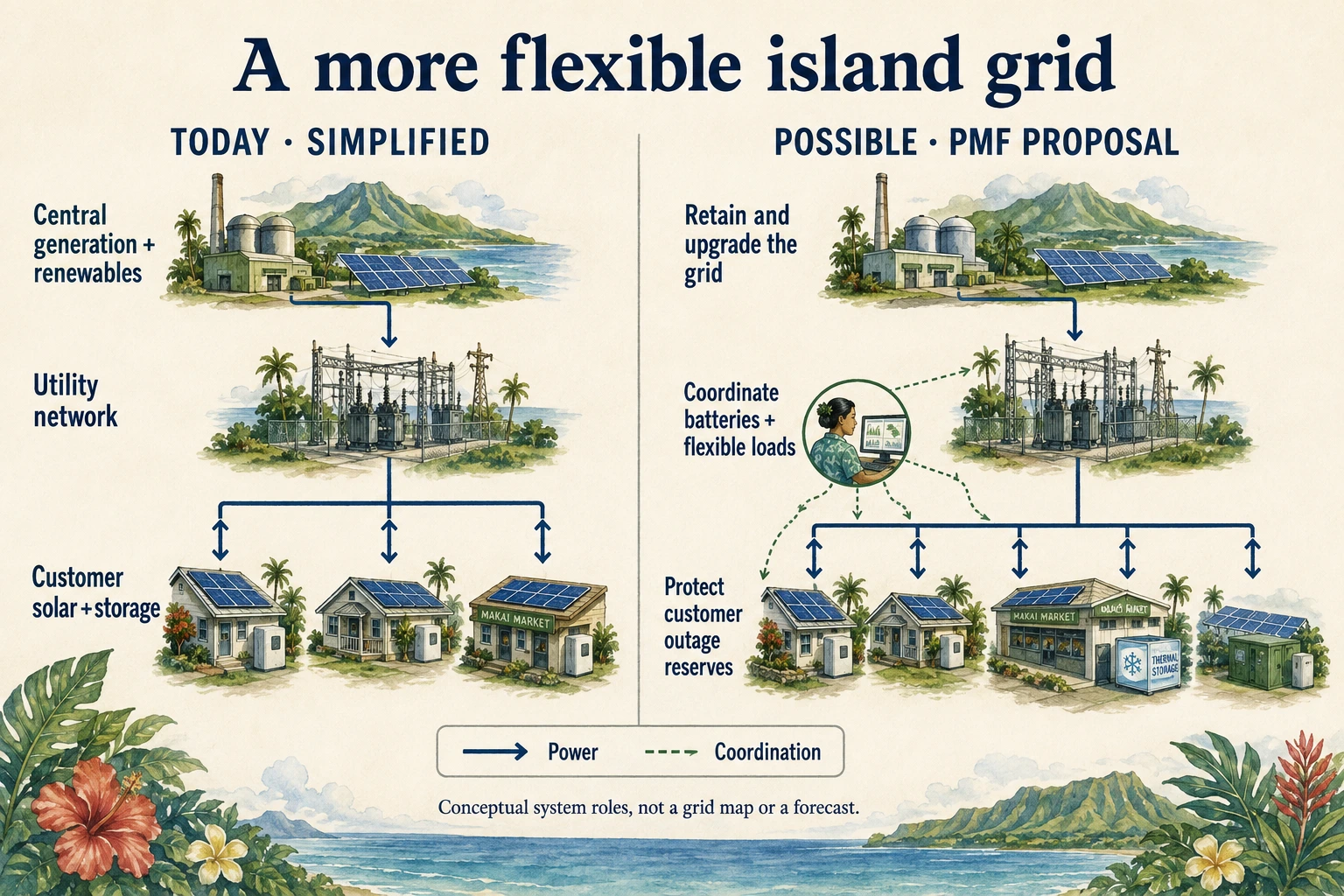
AI-generated concept · Customer resources work alongside the utility network.
Recommendation
Adopt an imported-fuel full-cost and retirement test.
PMF recommends that the Public Utilities Commission condition any LNG-related cost recovery on an independently reviewed all-resource portfolio comparison. The record should include system reliability need, total customer cost, lifecycle emissions, land and water impacts, fuel availability, public safety, alternatives, and a binding retirement or conversion plan.
The comparison should distinguish energy, capacity, grid-forming capability, reserves, black-start needs, transmission, and distribution constraints. A battery fleet can address some of these needs, but not all. An LNG plant can address some, but it also carries imported-fuel and asset-utilization risks. Clear definitions prevent one resource from being credited for services it cannot actually provide.
This recommendation does not pre-judge a procurement result. It sets a higher evidence standard for an irreversible, long-lived imported-fuel commitment than for a claim that a short-term fuel discount is enough to protect customers.
1
independent review before cost recovery
100%
major assumptions published
01 / 04
What is known
AI-generated concept · Hypothetical LNG infrastructure, not an existing Hawaiʻi terminal or selected project.
Evidence and implementation
Implementation update: delivered cost and declining utilization
September 7, 2026 update. A defensible comparison separates fuel substitution, replacement-plant efficiency, infrastructure costs, and the service required from each portfolio.
Evidence reviewed September 7, 2026
Reconcile the analyses on comparable assumptions
Evidence & PMF analysisResearch model · source context
HSEO’s updated fuel scenarios identify potential LNG benefits under specified assumptions. UHERO’s April analysis examines delivered fuel costs and the contribution of plant efficiency. The April critique is not an audit of every subsequent May update.
Sources: Alternative Fuels, Repowering and Energy Transition Study (Hawaiʻi State Energy Office)What the LSFO–LNG price comparison really shows (UHERO)
PMF recommendation
PMF recommends a common comparison workbook with dated inputs, disclosed exclusions, and consistent plant efficiencies. Show the value attributable to replacing an inefficient plant separately from changing its fuel. A low commodity price is insufficient evidence when delivery infrastructure, contractual minima, or a different operating schedule changes the customer cost.
Test the fixed-cost burden as output falls
PMF recommendationPMF recommends testing declining utilization explicitly. The chart holds annual fixed cost constant and indexes cost per unit of output against utilization. It applies to any fixed-cost asset and forecasts neither LNG prices nor a particular plant’s dispatch. It isolates one risk that an average fuel-cost comparison can conceal.
The decision record should then combine utilization with contract minima, financing, operating costs, and retirement obligations. Evaluate whether flexible contract volumes or a smaller installation can meet the residual reliability need. Customers should see the cost of retaining an asset that operates less often as other resources expand.
Less utilization increases fixed cost per unit of output
A normalized arithmetic comparison for any asset with fixed costs. This is not an LNG fuel-price forecast or a complete project cost model.
| Utilization | Fixed cost per output unit |
|---|---|
| 100% | 1× |
| 80% | 1.25× |
| 60% | 1.6667× |
| 40% | 2.5× |
| 20% | 5× |
Index = 1 ÷ utilization, with utilization expressed as a fraction and fixed cost held constant. The reference is 1× at 100% utilization. Fuel, variable operating costs, contract minima and revenues are excluded. UHERO’s April analysis is not an audit of every subsequent HSEO update.
Source context · reviewed September 7, 2026
- Alternative Fuels, Repowering and Energy Transition Study — Hawaiʻi State Energy Office. Fuel-focused scenarios, not an approved project or complete all-resource comparison.
- What the LSFO–LNG price comparison really shows — UHERO. Scenario-dependent critique; March 31 futures inputs are not current price quotes.
Require one service standard and a complete emissions boundary
PMF recommendationIEA’s LNG assessment addresses supply-chain emissions; end-use combustion and avoided fuel-switch emissions sit outside that scope. A complete electricity comparison must account for these components consistently.
Sources: Assessing emissions from LNG supply and abatement options (International Energy Agency)
PMF recommends independent evaluation of central generation, efficiency, renewable supply, storage, flexible demand, and network options against the same reliability requirement. Retain a rebuttable option for a narrow need that alternatives cannot meet. Approval should identify the evidence supporting that exception, allocate construction and fuel risks explicitly, and establish an enforceable retirement or conversion obligation.