
RESEARCH · WHITE PAPER · September 2026 · Policy research · 10 min
Federated batteries for Hawaiʻi: capacity at the customer meter.
A virtual power plant is a contract and operating system, not a metaphor. Hawaiʻi can use customer batteries and controllable thermal loads to provide measured capacity, load shifting, and fast response while protecting household reserve energy and customer choice.
2030
statutory goal year for new DER installations
3
values named in statute: resilience, capacity, ancillary services
2026-0084
active Hawaiʻi VPP proceeding
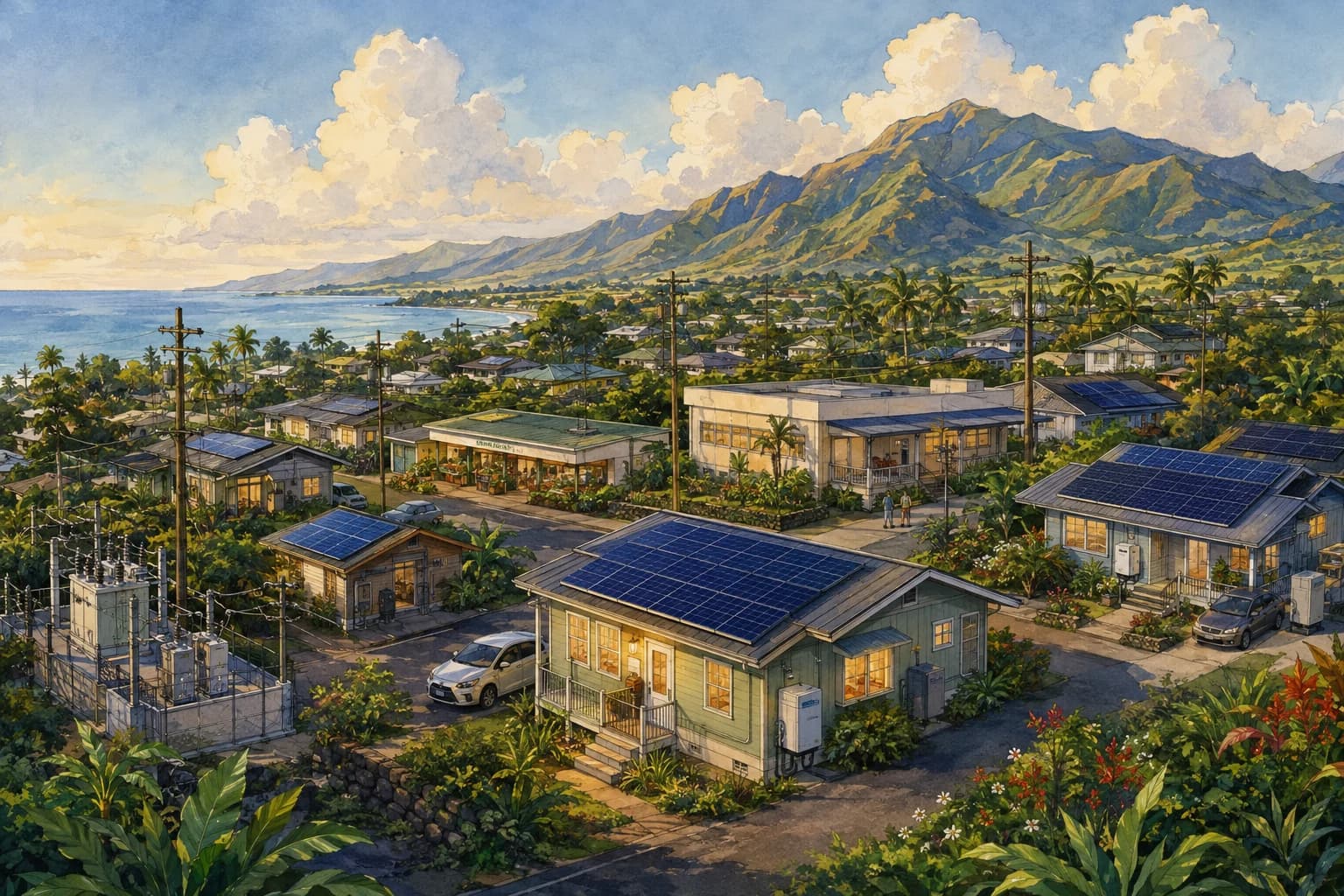
AI-generated concept · Customer resources work alongside the utility network.
Policy window
The statutory framework now calls for customer-sited capacity.
Act 266 of 2025 requires the Public Utilities Commission to establish a goal for the installation, by 2030, of new customer-sited distributed energy resources. It also directs the Commission to establish grid-services, microgrid, and community-renewable tariffs with storage riders, aggregation provisions, and device-level measurement and verification for storage.
In April 2026, the Commission opened Docket No. 2026-0084 to design a Virtual Power Plant grid-services program across Hawaiian Electric’s service territories. Its initial guidance calls for remote dispatch, performance-based compensation, and expanded access for low- and moderate-income households. That makes the central design question practical: what must a customer receive in return for making a device available to the grid?
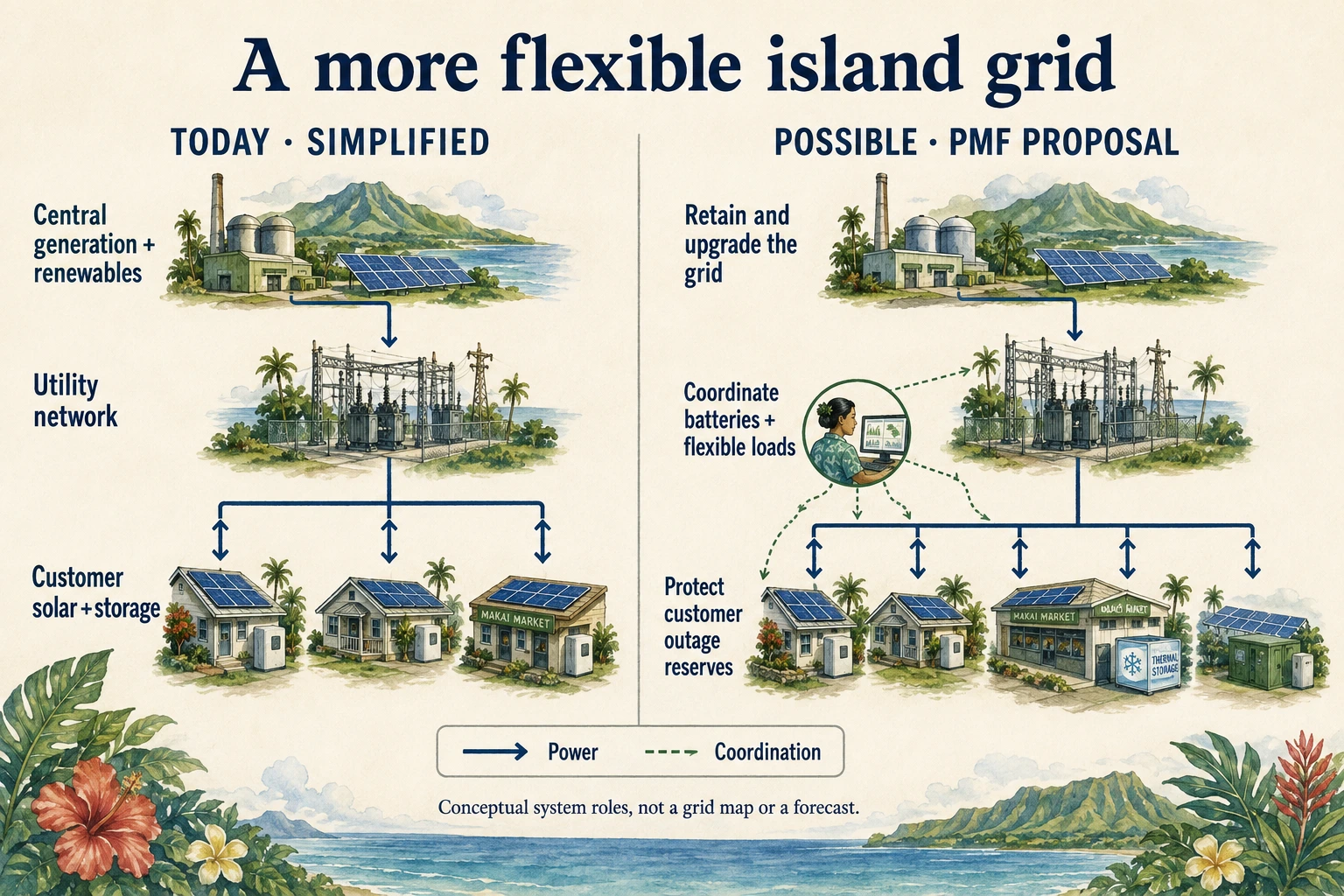
The policy should use the term federated fleet rather than a single, centralized plant. The resources remain owned or hosted at homes and businesses, but they can respond in a coordinated way when a tariff, contract, and communications system make that service reliable. The public value is measured performance at a known time and location, not the number of devices enrolled.
1
statewide goal for DER installations by 2030
0
extra meter required by statute for storage M&V
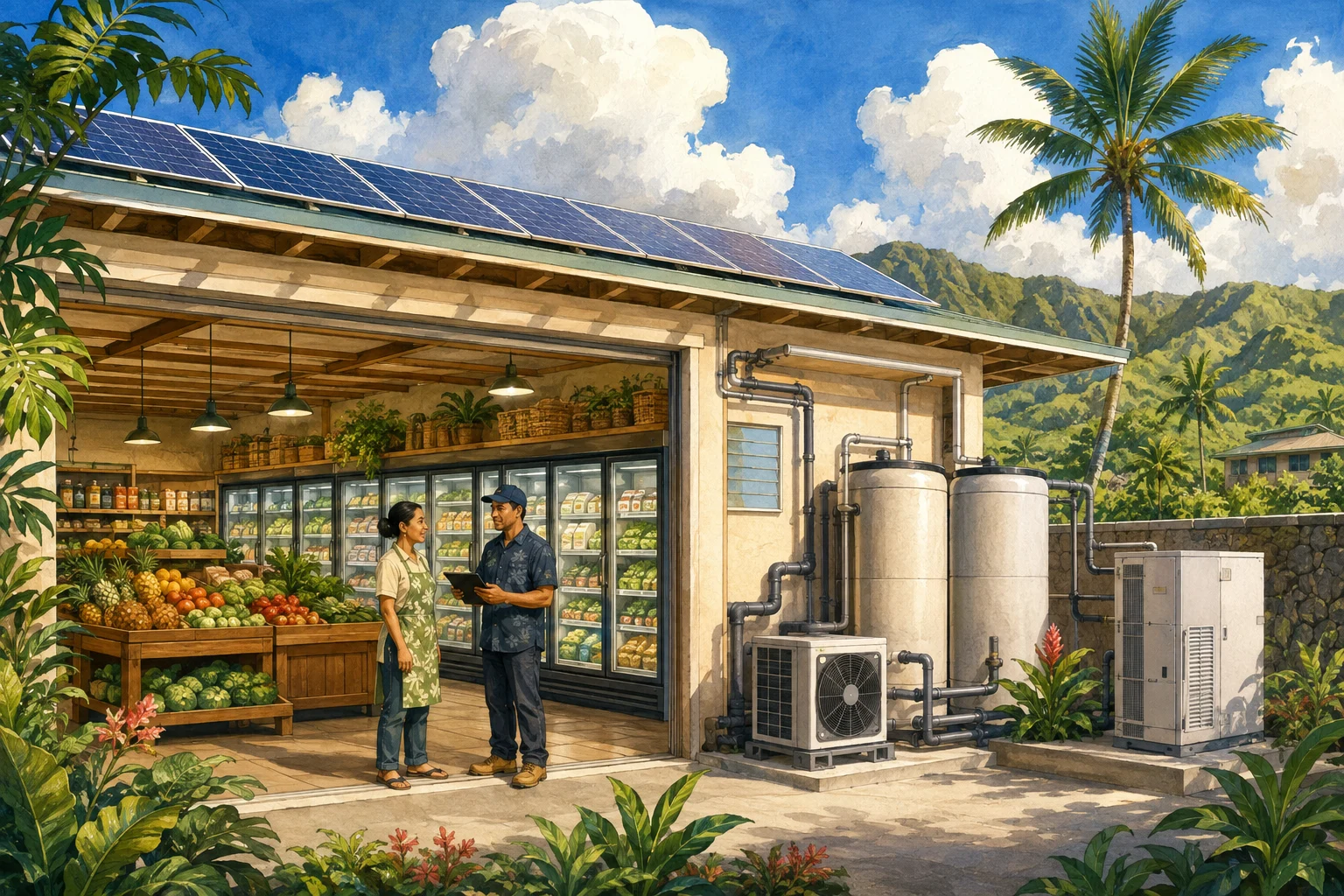
AI-generated concept · Cold-chain services, thermal storage and local maintenance.
System role
A fleet can compete for defined services; it cannot replace every grid asset.
The U.S. Department of Energy defines virtual power plants as aggregations of distributed energy resources—such as solar-plus-storage, controllable appliances, electric vehicles, and flexible loads—that can provide utility-scale and utility-grade services. In Hawaiʻi, those services can include evening capacity, ramp management, contingency response, and local load reduction when a feeder is constrained.
A federated battery-and-thermal fleet can reduce the need for selected centralized investments when it can deliver a contracted service with comparable confidence. It is not a substitute for all transmission, distribution protection, black-start capability, long-duration energy, or 24-hour firm supply. Planning must test each need separately rather than treating all kilowatts as interchangeable.
Thermal equipment expands the menu of flexible resources. A heat-pump water heater, ice storage, efficient cooling system, or refrigerated case can shift energy use when service temperatures remain within agreed limits. The control strategy must preserve customer comfort, food safety, and equipment warranties before it creates a grid dispatch option.
MW
capacity must be measured, not inferred from enrollment
kWh
energy duration remains a separate requirement
01 / 04
Policy window
AI-generated concept · Customer resources work alongside the utility network.
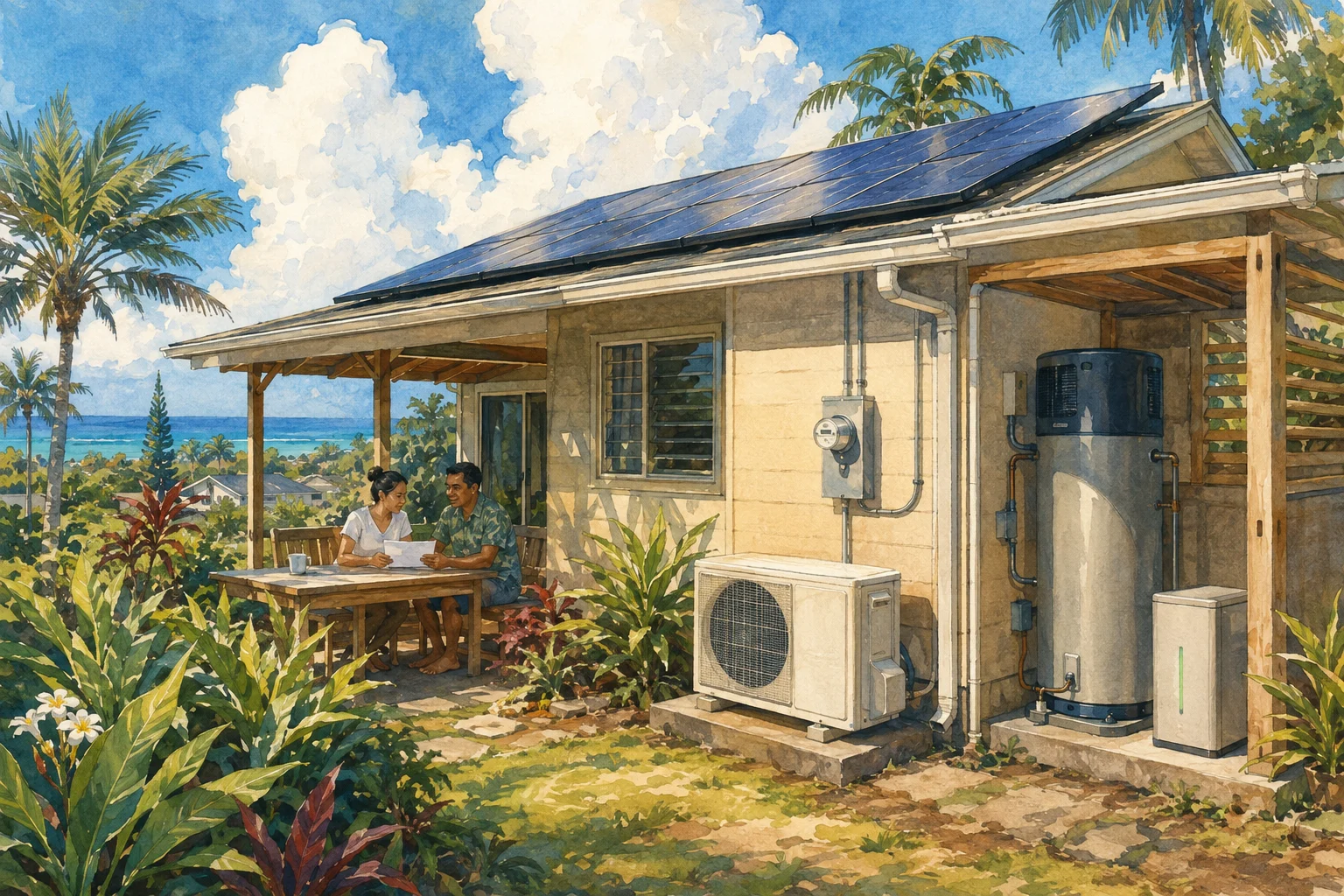
AI-generated concept · Household comfort, efficient equipment and a clear customer offer.
Customer contract
The reserve belongs to the customer unless the customer agrees otherwise.
Hawaiʻi law directs the Commission to establish compensation values for the resiliency, capacity, and ancillary-service value of participating solar-plus-storage systems. That instruction is important because it moves the discussion beyond a single export price. It does not remove the need for clear contracts, independent measurement, and customer protections.
A credible VPP tariff should specify the minimum state of charge reserved for an outage, permitted dispatch windows, response time, notification rules, opt-out rights, payment calculation, equipment communications, warranty boundaries, and the consequences of a failed dispatch. Health, safety, storm, and public-safety-power-shutoff conditions require explicit customer overrides.
PMF recommends an equity adder for income-qualified households, no retail sale of device or usage data, open interoperability requirements, minimum cybersecurity controls, and public annual reporting on bill effects, dispatch performance, overrides, and feeder-level benefits. These are policy recommendations, not requirements currently set by the Commission.
5+ years
recommended minimum term for durable grid-service contracts
100%
customer consent before participation
AI-generated concept · Customer resources work alongside the utility network.
Portfolio test
Procure the service, then compare the resource portfolios.
Hawaiian Electric’s July 2026 integrated-grid-planning solicitation seeks renewable energy, grid-forming resources, and firm capacity through a Commission-supervised process. The utility has said that firm-generation options should be evaluated in a transparent forum rather than presumed through a sole-source arrangement.
The same discipline should apply to federated capacity. A procurement should state the required location, availability window, duration, response, telemetry, outage reserve, and customer-protection terms, then allow utility-scale storage, customer batteries, controllable thermal load, efficiency, and targeted network upgrades to compete on measured total value.
This is a planning standard, not an argument that one resource class always wins. A decentralized portfolio may be faster to deploy, may reach customers who need bill relief, and may avoid some grid constraints. It may also have higher coordination costs or be unable to meet a particular system need. The evidence should decide the mix.
465 MW
grid-forming resources sought in Hawaiian Electric’s July 2026 RFP
1,650 GWh
variable renewable energy sought in that RFP
03 / 04
Customer contract
AI-generated concept · Household comfort, efficient equipment and a clear customer offer.
Evidence and implementation
Implementation update: enrollment, duration, and verified capacity
September 7, 2026 update. Existing enrollment provides a starting point. Reliable capacity remains a separate measurement and planning question.
Evidence reviewed September 7, 2026
Read the existing commitments accurately
Evidence & PMF analysisUtility-reported data · source context
Hawaiian Electric’s end-2025 table reports legacy SDP commitments of 42.61 MW from 5,565 Oʻahu customers and 8.15 MW from 1,159 Maui customers. BYOD Plus on Oʻahu reports 0.40 MW from 52 customers. These are enrollment and rated commitments, not firm capacity or a measured growth trend.
Sources: 2026 Annual CER Program Review, Table 4 (Hawaiian Electric)
Utility-reported data · source context
The utility’s export-only analysis cannot observe self-consumption. Device output, net site load, and export therefore require separate treatment when evaluating performance.
Sources: 2025 Annual CER Program Goals, pp. 18–19 (Hawaiian Electric)
Utility-reported data · source context
Green Mountain Power’s January 16, 2026 regulatory testimony reports that storage and other flexible loads produced more than $11.6 million in power-supply savings in 2025 and more than $26 million cumulatively since 2022. This is a positive operational comparison, with clear limits: utility-reported results, not an independent audit, a battery-only attribution, or a Hawaiʻi cost benchmark.
Sources: Joshua Castonguay regulatory testimony, pp. 8–9 (Green Mountain Power)
Source context & PMF recommendation
PMF recommends preserving the different evidence types in these cases. An announcement, rated enrollment, and reported savings should not be treated as interchangeable performance measures.
Sources: SHARE launch announcement (PG&E)2026 Annual CER Program Review, Table 4 (Hawaiian Electric)Joshua Castonguay regulatory testimony, pp. 8–9 (Green Mountain Power)
| Case | Evidence available | What it establishes |
|---|---|---|
| SHARE | Program announcement | Planned coordination and equipment deployment; no measured MW result. |
| Hawaiian Electric | Rated enrollment commitments | Existing participation and program scale; not firm capacity. |
| Green Mountain Power | Utility-reported operational savings | Reported power-supply savings from storage and other flexible loads. |
An existing resource base, with different program sizes
Hawaiian Electric’s end-2025 rated commitments. The newer BYOD Plus program is shown separately from legacy SDP; these values are not firm capacity or a trend forecast.
| Program / island | Rated commitment | Customers |
|---|---|---|
| Legacy SDP · Oʻahu | 42.61 MW | 5,565 |
| Legacy SDP · Maui | 8.15 MW | 1,159 |
| BYOD Plus · Oʻahu | 0.40 MW | 52 |
All bars use the same MW scale. Customer counts are reported in the table and are not plotted as power. Export-only analysis does not reveal all energy used behind the meter.
Source context · reviewed September 7, 2026
- 2026 Annual CER Program Review, Table 4 — Hawaiian Electric. End-2025 enrollment and rated commitments, not firm capacity.
- 2025 Annual CER Program Goals, pp. 18–19 — Hawaiian Electric. Export-only analysis does not observe self-consumption.
Apply the power, energy, and location limits together
PMF recommendationPMF recommends duration-specific qualification. The scenario below applies assumed power, usable energy, customer reserve, availability, and feeder limits to the same fleet. Longer events exhaust energy even when inverter power is unchanged. The inputs are illustrative; assumed availability is not a measured confidence interval or regulatory capacity credit.
Before substituting a fleet for a central investment, require chronological adequacy and distribution studies, a recharge plan, and tests of correlated failures. Weather, communications, customer behavior, and a constrained feeder can affect many devices together. A simple sum of ratings cannot resolve those risks.
Duration changes what a battery fleet can deliver
An illustrative fleet constrained by AC power, available energy and a 4 MW feeder ceiling. This scenario is not an accredited capacity value or a reliability forecast.
| Duration | Power limit | Energy limit | Feeder limit | Scenario output |
|---|---|---|---|---|
| 1 h | 4.5 MW | 6.3 MW | 4 MW | 4 MW |
| 2 h | 4.5 MW | 3.15 MW | 4 MW | 3.15 MW |
| 4 h | 4.5 MW | 1.575 MW | 4 MW | 1.575 MW |
| 8 h | 4.5 MW | 0.7875 MW | 4 MW | 0.7875 MW |
Equation and assumptions
MW = min(N × 5 × a ÷ 1,000; N × 10 × (1 − r) × a ÷ (h × 1,000); 4).
N is enrolled homes; a is assumed event availability; r is customer reserve; h is event hours. Each home has 5 kW AC power and 10 kWh AC usable energy before reserve. Availability constrains both power and energy. There is no recharge during an event.
The initial scenario uses 1,000 homes, 30% reserve and 90% availability. The 4 MW feeder ceiling is illustrative. Availability is a simplifying assumption, not a measured confidence interval. Chronological adequacy, dispatch response, local network conditions and rebound require separate evaluation.
Source context · reviewed September 7, 2026
- Order 42488 — VPP design proceeding — Hawaiʻi PUC. Docket 2026-0084; proposed design questions are not an adopted tariff.
- 2025 Annual CER Program Goals, pp. 18–19 — Hawaiian Electric. Export-only analysis does not observe self-consumption.
Turn the design proceeding into a service contract
PMF recommendationThe PUC’s Order 42488 opened the VPP design proceeding in Docket 2026-0084. Its design questions are not an adopted tariff.
Sources: Order 42488 — VPP design proceeding (Hawaiʻi PUC)
PMF recommends separate compensation for being available and for delivering the requested service, with customer reserve and override rules established first. Require auditable telemetry, proportionate performance consequences, and transition rights if an aggregator exits. Procurement should state which central service may be displaced and retain a contingency plan until the replacement portfolio demonstrates the required performance.