
RESEARCH · WHITE PAPER · September 2026 · Policy research · 8 min
Commercial cooling and refrigeration are an affordability strategy.
For a grocer, clinic, food business, school, farm, or small manufacturer, the energy system is part of daily operations. Hawaiʻi can lower operating costs and improve resilience by treating efficient thermal equipment, controls, storage, and finance as one implementation program.
20 years
commercial GEM$ on-bill financing maximum
6
named efficiency categories, plus solar and other approved measures
1
commissioning record per participating site
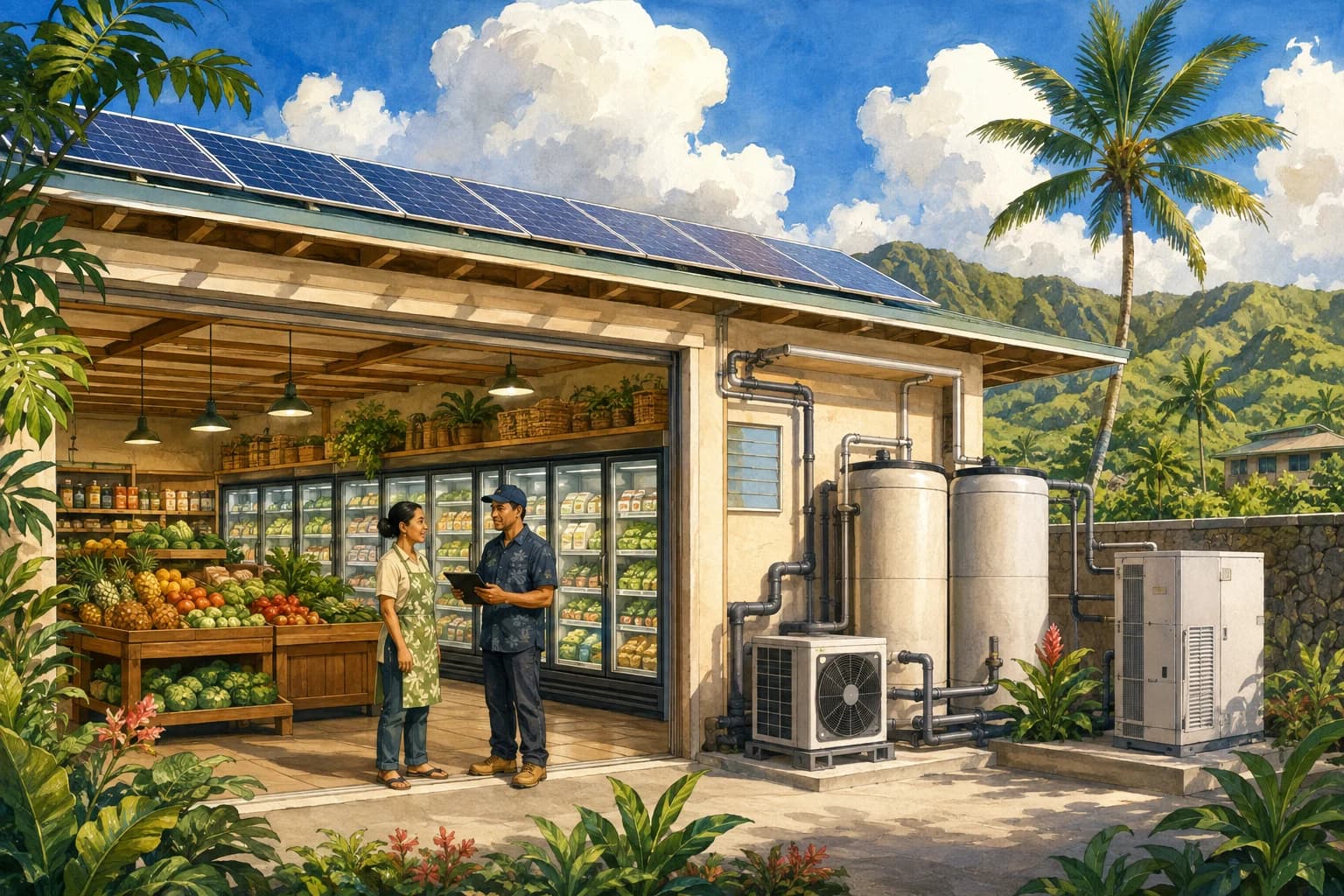
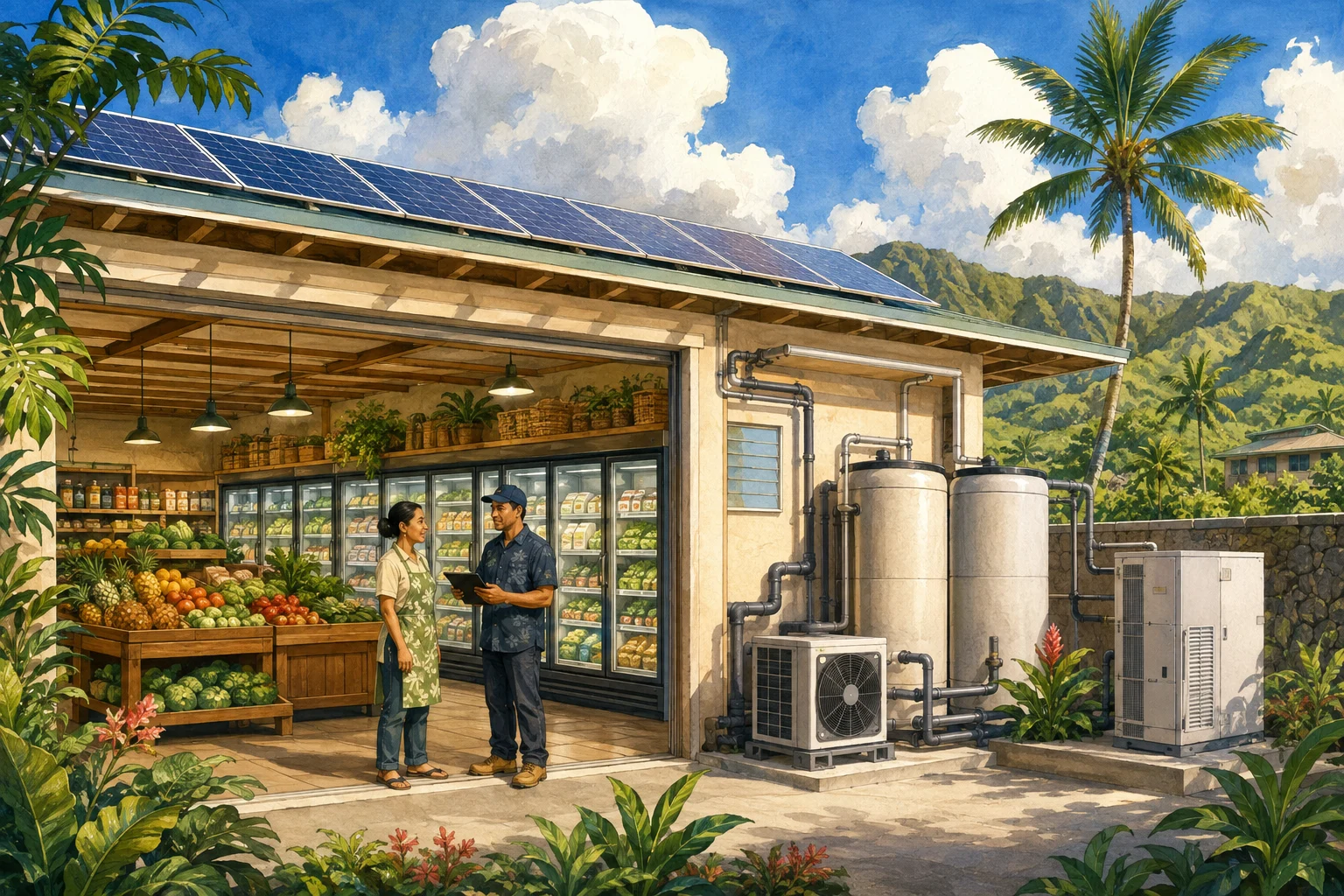
AI-generated concept · Cold-chain services, thermal storage and local maintenance.
Essential operations
Start with the services a business cannot lose.
Hawaiʻi’s Green Infrastructure Authority lists commercial HVAC, water heating, thermal-storage pumps, motors, building-envelope measures, refrigeration, and other approved efficiency technologies as eligible improvement categories. Hawaiʻi’s RPS does not count electrical-energy savings after 2014, so these measures should be justified by customer, system, and resilience value—not asserted RPS credit. Together, they are a broad enough starting point to address loads that drive bills and operational exposure in many customer-serving facilities.
A commercial resilience plan should begin with an essential-service inventory: cold storage, food safety, safe indoor conditions, communications, medical or operational equipment, water pumping, and cash or point-of-sale systems. The inventory should establish what must run, for how long, and on which circuit before a project claims outage capability.
Integrated thermal-electrical hardware can be valuable where it reduces peak demand, shifts operation to periods of lower system cost, or preserves a defined essential load. It must be selected from the facility’s load profile, site constraints, maintenance capacity, and safety requirements—not from a generic equipment bundle.
1
critical-load plan before resilience marketing
0
assumed backup hours without a load study
AI-generated concept · Cold-chain services, thermal storage and local maintenance.
Thermal value
Thermal storage turns comfort and cold-chain equipment into flexible demand.
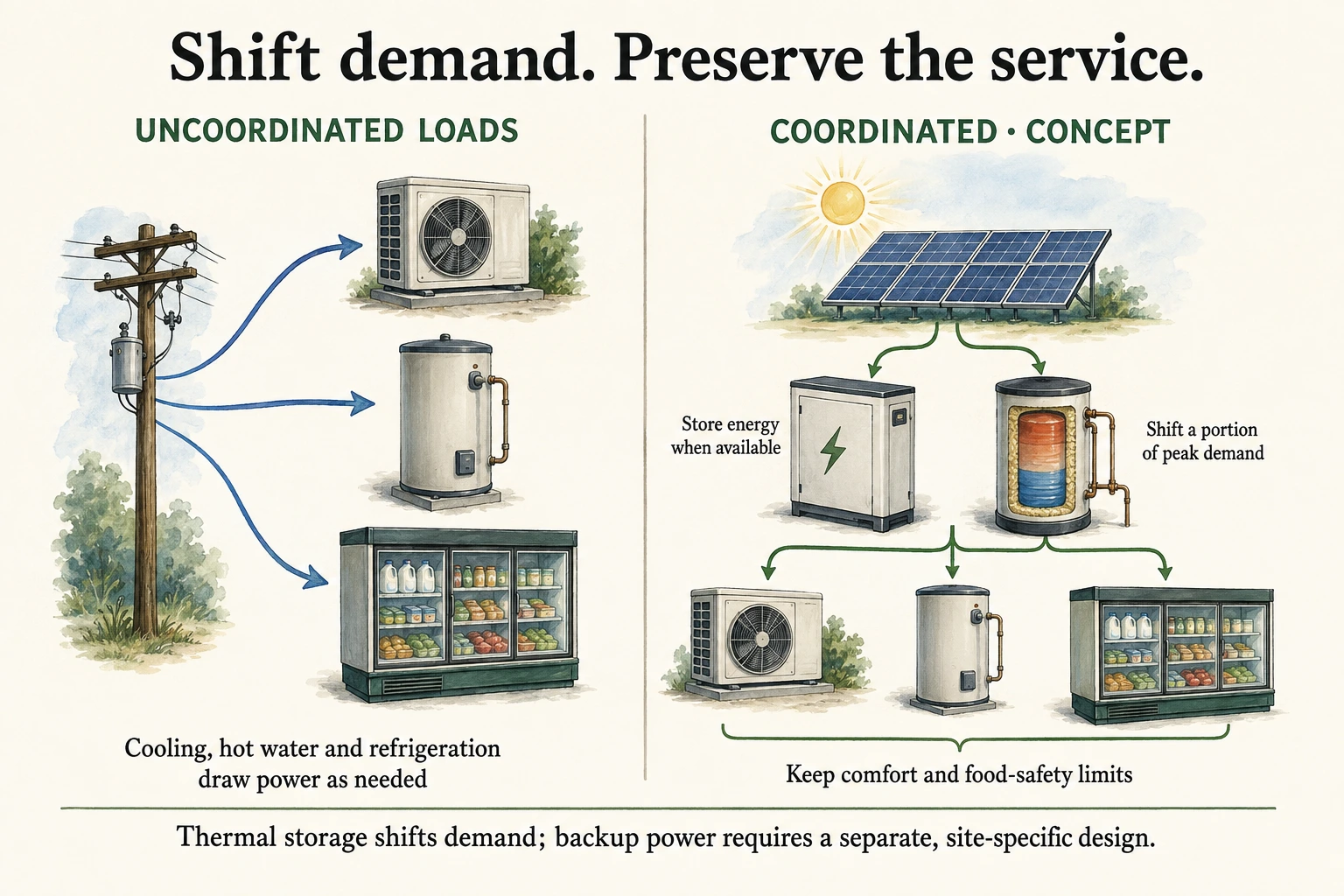
Hawaiʻi law includes heat-pump water heating and ice storage in its definition of renewable electrical-energy savings, but the renewable portfolio standard does not count electrical-energy savings after 2014. The definition supports an efficiency policy discussion; it does not give an individual thermal measure current RPS credit. A thermal tank, stored ice, or well-controlled refrigerated load can still move electricity use in time while preserving the service the customer actually needs.
The operating limits matter. A controller should never reduce cooling, hot-water availability, or refrigeration below agreed service and safety thresholds to chase a grid payment. Equipment manufacturers, installers, and facility operators should document setpoints, health and food-safety safeguards, warranty constraints, manual override, and recovery behavior before enrolling a load in a grid-services program.
For buildings with solar and batteries, controls should coordinate rather than compete: efficiency reduces the load to be served, thermal storage shifts a portion of that load, the battery covers the remaining electrical service, and grid dispatch occurs only within the facility’s approved operating envelope.
4
core controls: service limits, safeguards, override, recovery
1
facility-approved operating envelope
01 / 04
Essential operations
AI-generated concept · Cold-chain services, thermal storage and local maintenance.
AI-generated concept · Cold-chain services, thermal storage and local maintenance.
Capital stack
Use existing finance tools before creating new barriers.
HGIA’s on-bill program serves eligible nonprofits, small businesses, commercial tenants, and multifamily projects, subject to program and property-owner requirements, with published terms of up to 20 years. Its approved commercial measures include HVAC, water heating, thermal storage, motors, building-envelope work, refrigeration, solar photovoltaic systems, and other approved efficiency technologies.
Hawaiʻi’s C-PACER program provides another path for owners and developers to access private-sector financing for qualifying energy-efficiency, renewable-energy, water-conservation, and resilience improvements. It can be suitable for longer-lived commercial projects, but transaction costs, mortgage-lender consent, and savings assumptions must be evaluated case by case.
PMF recommends a simple capital stack: confirmed rebates and grants first; conservative bill savings to support repayment; performance contracts or C-PACER where appropriate; and grid-services revenue treated as upside until it is contracted. Every offer should disclose maintenance, warranty, replacement, transfer, end-of-term ownership, and customer data terms.
2
public finance paths: on-bill and C-PACER
1
plain-language life-cycle cost disclosure
AI-generated concept · Cold-chain services, thermal storage and local maintenance.
Delivery standard
Pay for verified outcomes and keep the record public.
A public or ratepayer-supported program should pay against an implementation record: baseline data, equipment specification, permits, commissioning, bill impact, grid-service performance where enrolled, maintenance plan, and warranty status. The record can protect customer confidentiality while still allowing public reporting of portfolio outcomes.
Contractor capacity is part of policy design. Program rules should use licensed and qualified contractors, pay for commissioning and maintenance rather than only installation, and make corrective work available when performance falls short. A cheap install that cannot be serviced locally is not an affordability program.
The result is a practical industrial policy: deploy equipment that makes homes and businesses more comfortable and productive, reward measured reliability and savings, and build local capability to install, maintain, and improve it. The technology can evolve; the public standard should remain durable.
7
minimum implementation-record fields
1
annual public portfolio scorecard
03 / 04
Capital stack
AI-generated concept · Cold-chain services, thermal storage and local maintenance.
Evidence and implementation
Implementation update: thermal service portfolios
September 7, 2026 update. Commercial pilots should be organized around operating requirements and maintenance capability, with grid services qualified after essential service is secured.
Evidence reviewed September 7, 2026
Match the technology to the useful heat requirement
Evidence & PMF analysisTechnical guidance · source context
DOE’s onsite-energy resources describe technologies whose suitability depends on site requirements, including the temperature and economics of process heat. They do not support a universal claim that one heat-pump system can replace every industrial heat source.
Sources: Onsite energy technologies (U.S. Department of Energy)
PMF recommendation
PMF recommends an audit of temperature, flow, hours, simultaneous heating and cooling, and acceptable interruptions. Examine heat recovery and efficient controls before sizing storage. Some facilities may support a useful combined package; others need separate equipment or a retained process-specific heat source.
Run distinct pilots for distinct operating duties
PMF recommendationPMF recommends separate pilots for hospitality hot water, food refrigeration, and suitable industrial process heat. Each should have an operator-approved service specification and commissioning procedure. Combining their financial results without disclosing duty cycles would hide the conditions that make a project useful or uneconomic.
Compare efficient equipment, heat recovery, thermal storage, and batteries at the same service level. Include maintenance labor, replacement parts, downtime, and controls integration in cost. The public record should identify the operating conditions under which a result transfers to another facility, including where it does not.
Separate backup capability from an islandable network
PMF recommendationPMF recommends documenting essential circuits, protection boundaries, starting loads, available energy, communications, and restoration sequence before making a commercial resilience claim. A grid-connected battery may provide flexibility without being configured to run a facility during an outage. A microgrid requires an additional engineered operating and protection plan.
Begin shared-service projects with a bounded campus or facility partnership and identify the applicable legal authority before using utility wires. Contracts should name who operates the system during a fault, who authorizes restoration, and who maintains the protection settings. Those responsibilities belong in the procurement, not in an emergency improvisation.